

6 steps to get your Peak Season planning back on track
Peak season (BFCM, holiday shopping, etc...) is coming soon. Your e-commerce business is already prepped. But if you’re getting that nagging feeling that some bases are not covered, you’re probably right. That’s because most e-commerce experts share advice about how to get customers INTO the sales funnel but neglect the final leg of the customer buying journey–the delivery experience.
A few short years ago, this oversight might not have had a significant impact on your business. But today, a bad delivery experience can devastate a meticulously planned customer journey and upend all your efforts to give customers the best possible buying experience.
There’s a simple reason behind it. During peak season, customer anticipation is at its highest. They are ready to spend–not for themselves, but for their loved ones. That raises the stakes because if hiccups occur, you risk disappointing your customers AND the people around them.
During this period, your customers need to know your business can handle their orders and keep fulfillment promises. Otherwise, they’re never coming back–peak season or not.
Here’s a quick reality check. Your customers are already unhappy with their peak season delivery experience. 60% of them say their last post-checkout experience was underwhelming. 83% of them claim to be disappointed with the service they received after their online purchases. 56% of them think brands do not care about their experience after they hit the buy button.
And 92% of these unhappy customers say they will stop buying from your business after a single bad experience. Long story short, a bad delivery experience can increase churn and waste your precious acquisition dollars.
Now for the good news.
There are several strategies you can use to refine your delivery experience to exceed customer expectations. But to make it easy for you, we’ve narrowed down to the top 6 strategies that can have the biggest impact on your business in the shortest amount of time–around 30 days to be exact.
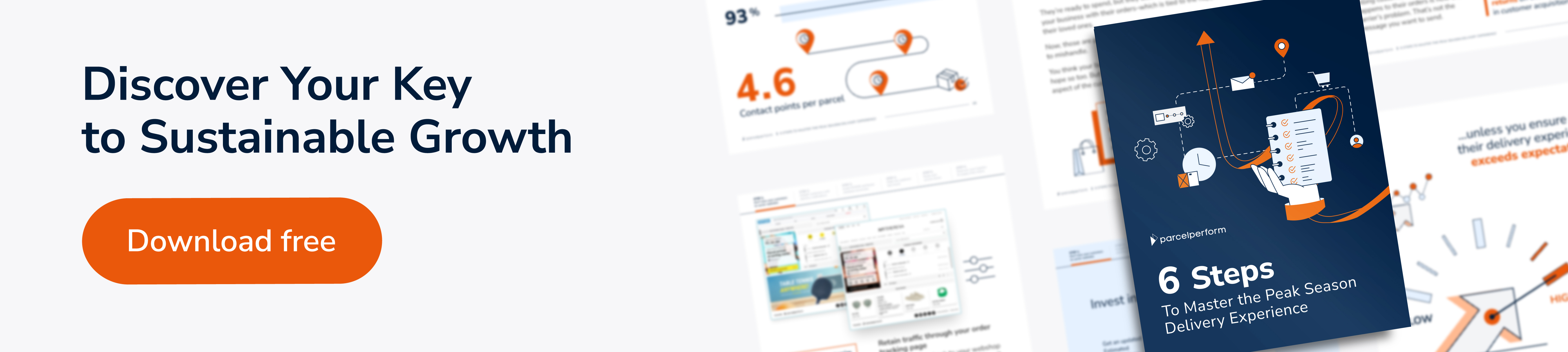
Step 1: Don’t lose your customers to carrier websites
In the past few months, you’ve spent a substantial amount of marketing dollars on driving traffic to your online store. Some of that traffic converted and became loyal customers. However, these loyal customers get sent to third-party carrier sites when they want to track their orders.
When that happens, your business is sending customers away during the post-checkout phase. You’re telling customers that what happens to their orders is now the carrier’s problem. That’s not the message you want to send.
What you can do instead is host tracking information on your own website. Instead of sending customers away, you can use an order tracking page to keep customers within the branded environment of your webstore.
This approach keeps your brand top of mind for customers and provides a channel for upselling or cross-selling. Research shows that brands that customize the post-purchase experience see two to three times higher returns on their investment in customer acquisition.
Step 2: Delight your customers with delivery notifications
After clicking on the “buy” button, your customers want to know that they will get their order. They want to know that their order is being packed, sent from the warehouse, picked up by the carrier, and well on its way to their destination.
This need for assurance is why shipping notifications have an open rate of 80%. Far more than any other notifications your business sends. But unfortunately, the delivery process is oftentimes an abyss that serves little to no information.
This lack of information does nothing to assure your customers–and build confidence in your ability to deliver. E-commerce businesses can take a proactive approach to change this status quo.
By sending customers notifications when delivery milestones are met, you communicate the information they care about–and expect from your business. That gives you their undivided attention, where you can serve up product recommendations to trigger the next purchase–or at least the interest to do so.
Step 3: Prevent “where is my order” (WISMO) requests
WISMO requests are triggered when customer frustrations boil over. It happens when your customers are so bothered by the lack of communication regarding their order that they take the time off to fire off a query to your customer service team. Needless to say, both parties can do without it.
Unfortunately, for many e-commerce businesses, WISMO queries are a fact of life. They can comprise up to 60% of the call volume your customer service team handles.
Today, we’re here to tell you it doesn’t have to be this way. If your business takes a proactive stance in keeping customers informed about their purchases (see step 2), you can potentially keep WISMO requests down to the bare minimum.
To further reduce WISMO numbers, your business can consider providing highly accurate estimated delivery dates (EDD). With EDDs generated by machine learning processes, you also give customers the confidence to checkout–which can potentially increase checkout conversion rates by up to 10%.
Step 4: Help the customer feel heard and understood
Customers may be demanding, but there’s a simple reason behind it. They want to know your business hears their feedback and is committed to providing the products and services they need. If your customers have no channel to express their preferences (or frustrations), they will express it through their wallets.
They either buy again or they don’t.
As an e-commerce business, you most likely care about your customers. But proving it can be a struggle. Your business needs to have an extremely active customer service team, social media team, product team, marketing team, and so on. That’s not financially feasible for most companies.
There’s a much simpler solution for this. Instead of beefing up each team (which you should get to eventually), you can simply implement a feedback rating system. This system can be tuned to capture customer sentiments regarding their entire journey, from discovery to unboxing.
From our experience, asking for a rating at the right time and the right segment of the buying journey can improve feedback rates by up to 20%!
Step 5: Equip your customer service teams with the right tools
The number one challenge customer service teams face is not the heavy workload. It’s not having the answers to your customers’ questions. During peak season, this problem intensifies as call volumes soar due to the inevitable delivery delays and bottlenecks.
As we mentioned earlier in step 3, the bulk of the tickets is WISMO-related. When you reduce time-consuming WISMO queries, your customer service teams get much more breathing room to focus on the complex issues that customers face.
With granular logistics tracking information, your customer service team will be much better equipped to resolve WISMO queries that come through quickly.
And here’s the really great news: Tools made to leverage tracking data and analytics can enable customer service workflow automation, and self-service tracking can further reduce WISMO by up to 45%.
One of our customers even documented a 20% increase in NPS collection rate simply by giving their customer service team the tools they need to improve their customers’ peak season delivery experience.
Step 6: Empower logistics and supply chain teams to handle increased load
Your logistics and supply chain teams are already under tremendous strain. Peak season could double or triple that pressure to ensure customers get their parcels on time for the holiday season.
At the same time, the team in charge of fulfillment needs to keep a keen eye on last-mile logistics costs and prevent them from piling up. This is where real-time logistics data analytics can play a huge role.
By providing your teams with real-time visibility via logistics data and analytics, they can select the most suitable carriers based on performance and SLA compliance during peak season. Having this visibility also helps them optimize fulfillment performance across carriers, products, and even markets.
The potential savings from such optimization can add up and drive up your peak season profits. And while these improvements may be happening behind the scenes, the impact on customer satisfaction cannot be overstated.
Your customers will more likely receive their orders within a reasonable time frame and are more willing to trust your business with their future holiday season orders.
Bonus step 1: Catch the customer's interest before and after checkout
The average cart abandonment rate is at 70.19%. That means 7 out of 10 shoppers lose interest before they even buy. There could be several reasons for this. They might have found a better deal somewhere else, or they decided at the last minute that they didn't want the item. Some of these reasons are beyond your control. However, more often than not, customers abandon the carts because of uncertainty about when their orders will arrive. With AI and machine learning technology, this is one barrier that you can finally remove for your customers.
AI-driven estimated delivery dates (EDDs) use carrier data and data from your internal systems to generate a highly precise, accurate, and ambitious EDD that customers can rely on. Merchants that use this advanced technology in their product pages often report up to a 23% increase in conversion rates. When AI-driven EDDs are displayed post-purchase, you can drastically reduce WISMO queries--because customers already know when their package will arrive. In short, not only do AI-driven EDDs help improve your business, they also help you reduce costs and improve revenue.
Bonus step 2: Post-peak season returns are coming. Embrace it!
Returns are a large part of the e-commerce industry. There will always be customers that are unhappy with what they bought. Buyers’ remorse, gifts in the wrong color, nagging spouse–the reasons are endless. According to recent data, UPS handled more than 60 million returns during the last peak season shipping season.
And as you’ve already experienced before, most of these reasons are not due to negligence on the part of your business. However, preparing for it is a necessity.
A seamless returns experience gives customers the confidence to buy (and buy again), even if they have no plans to return their order. According to a Klarna survey, 84% of UK online shoppers say they wouldn’t buy from a retailer again after a bad returns experience.
In recent years, technology has helped make prepping for returns much easier, and simpler. Merchants can now access digital tools that automate the returns process. These tools help reduce the workload for customer service teams, lower operating costs of the process, and equip your business with invaluable insights that can optimize how it handles future post-peak season returns.
Cover all your bases to offer a seamless customer experience.
Peak seasons are opportunities to supercharge profits. But it’s also a time when your e-commerce business experiences the highest amount of pressure. The tremendous strain on your team could force the business to get into survival mode just to keep it running. However, with the right strategy and careful planning, you will find the breathing room needed not just to survive but to thrive.
But even the most comprehensive strategies can have gaps that customers will fall through. Book a demo with our e-commerce experts to find out how you can cover all your peak-season bases and get your business through the toughest season of the year.

You might also like
AI Context Window Optimization for E-Commerce
Stop losing AI search traffic to DOM truncation. Optimize your first 4k tokens to dominate AI recommendations.
Apr 30, 2026
Parcel Perform
Why AI Agents Rank E-Commerce Operations Over Content
Stop hiding operational data in JavaScript. Learn why AI agents rank server-side trust facts over visual design.
Apr 17, 2026
Parcel Perform
The 6-Day AI Crawl: Why Your Ecommerce Product is Invisible
GPTBot crawls your site every 6 to 9 days. Discover why your new e-commerce product launches remain invisible.
Apr 17, 2026
Parcel Perform