

How to build a customer-centric business model for sustained growth
E-commerce brands are facing a slew of challenges today. Inflation, rising costs, lower consumer demand, and supply chain issues are just a few concerns that businesses juggle to compete in this highly competitive arena.
In these times of uncertainty, focusing on the backbone of your business, your loyal customers, is crucial. Read on to learn more about how increasing customer retention can help your brand achieve meaningful and sustainable growth.
Rising customer acquisition costs are eating into your profits
Customer acquisition is expensive. According to recent studies, it can cost your business 5x more to acquire new customers than to retain existing ones. To make it worse, ad costs on popular platforms like Google, Facebook, and Instagram are rising, and inflation is reducing consumer appetites, making it more difficult for you to convert them. This has contributed to an almost 50% increase in customer acquisition costs in just the last 5 years!
Despite your high investment in acquiring them, new customers are also less likely to make purchases (5-20%) than your existing customers (60-70%). With all the pressures customer acquisition puts on your bottom line, businesses can instead support their marketing and sales efforts with customer retention strategies.
Increase customer lifetime value for long-term growth
Nurturing loyal customers for your brand is an investment that can bring your business great returns. Customers who trust your business are more likely to purchase from you more often and in larger quantities. Loyal customers spend up to 67% more on products and services than new customers. Furthermore, during peak seasons, loyal customers are more likely to splurge on brands they know and trust and will spend 25% more per transaction at your stores.
Not only are loyal customers more eager buyers, they can also be your brand’s advocates, with 86% happy to recommend it to other potential customers. When consumers gain awareness of a brand from a source they trust, they may be up to 85% more likely to make a purchase.
Stay ahead of fierce competition with seamless and personal customer journeys
Great buying experiences are central to building a base of loyal customers. Consistent, seamless, and worry-free customer journeys help make strong impressions for your brand and make customers more likely to return time and time again. Once this trust is built, customers will even become more forgiving of negative experiences, with 46% likely to continue purchasing from your brand after one.
To unlock these benefits, ensure that customer experiences are streamlined from discovery to purchase and, especially, to the post-purchase journey. Retailers often neglect the delivery journey when curating customer experiences because it’s not under their control. However, it is a highly emotional step in the buying journey that can make or break your customer relationships if mismanaged.
Here’s what an effective post-purchase strategy should include:
Clear and personalized information to reduce customer confusion and build customer trust: Branded tracking pages are an excellent way to efficiently present information which can be accessed at any time. This will both satisfy customers and reduce WISMO (where is my order) inquiries for your customer service team.
Timely and useful notifications to avoid frustration during the emotional delivery process: Keep your customers in the loop at all the important moments from the first to the last mile and ensure that delivery issues are proactively addressed.
Accessible and effective customer service: Ensure that your teams are always equipped with the best information so they can quickly respond to queries and reassure customers that their orders are already on the way. And if not, update customers with information on delays.
These strategies can help you transform your post-checkout journey but implementation can be complicated and may take years to develop. An alternative solution would be to opt for
outsourced tools from industry experts. Their tools are built with your industry and challenges in mind and can get quite sophisticated.
They also have the resources to focus on developing incredibly strong features that you need, like a large portfolio of carrier integrations, enterprise e-commerce experience, and big data expertise. That means not only are your customers happy, but your backend team will also benefit from an industry-leading solution.
With logistics data, you can also effectively track carrier performance, and monitor SLA compliance to help you regain control over the delivery side of your business.
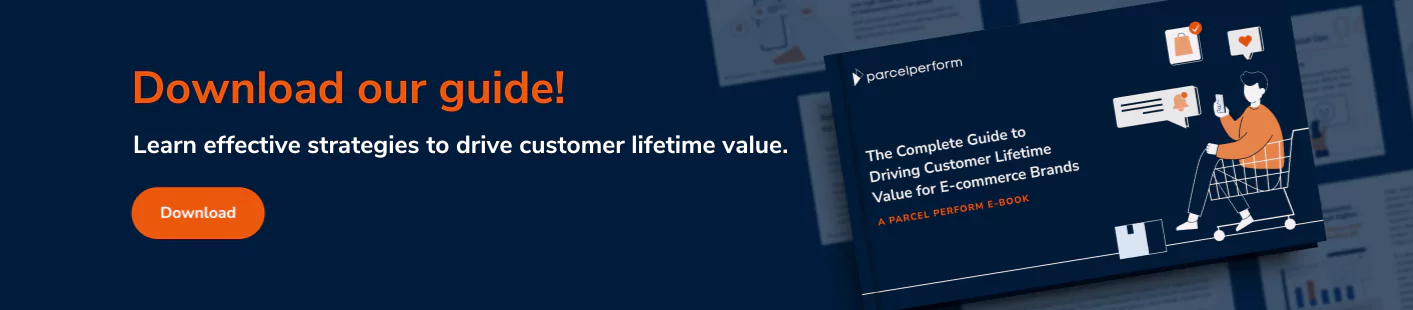
To find out more about how logistics data can improve your CLV, get our ebook "The Complete Guide to Driving Customer Lifetime Value for Ecommerce Brands" here.
You might also like
Why Predictive Logistics Beats Real-Time Dashboards for Ecommerce Ops
Stop reacting to supply chain delays. See how predictive logistics lowers costs and protects e-commerce margins.
Sep 04, 2026
Parcel Perform
Stop Delivery Delays: Boost Loyalty with Predictive Logistics
Stop delivery delays before they reach the customer. Use predictive logistics to protect margins and boost loyalty.
Sep 03, 2026
Parcel Perform
Predictive Logistics: How AI Turns Carrier History into Forward-Looking Decisions
Stop reacting to delays. See how AI turns historical carrier data into forward-looking logistics decisions. — Read on fo
Sep 02, 2026
Parcel Perform