

How AI Delivery Prediction Cuts WISMO Tickets Before They Happen
How AI Delivery Prediction Stops WISMO Tickets Early
The inbound tracking inquiry is a persistent operational leak that drains e-commerce margins. When retailers treat delivery performance as structured data, AI delivery prediction models catch delays and intercept these questions before a shopper ever reaches for the contact button.
When a customer cannot see exactly when their package will arrive, they ask. This dynamic creates an expensive operational burden for brands. The issue stems from fragmented carrier data and vague delivery windows that leave shoppers guessing. When expectations misalign with reality, support volume spikes and margins leak.
Predictive models change this equation. By analyzing historical transit times, regional anomalies, and carrier performance, the prediction engine generates highly accurate delivery dates. This data powers proactive communication, answering the customer's question before they ask it. The engine builds a leaner support operation and protects the bottom line.
The WISMO Epidemic: A Silent Drain on E-commerce Resources
The most common customer inquiry is also the most preventable. WISMO / WISMR inquiries dominate support queues because the standard post-purchase tracking experience fails to provide the one piece of information shoppers actually want: a specific, reliable date of arrival.
Retailers rely on static transit time estimates provided by carriers. These estimates rarely account for real-world delays, weather events, or localized network congestion. When a package misses that static window, the customer experiences a silent failure. The tracking page still says "in transit," but the expected date has passed.
This lack of visibility forces the customer to act. They email, call, or initiate a live chat. Each action pulls a human agent away from complex problem-solving to answer a question the predictive engine should have already resolved. The operational drag pulls resources away from revenue-generating activities.
Fixing this requires a shift in how retailers handle e-commerce logistics data. Instead of passing raw carrier statuses directly to the consumer, brands must interpret the data and translate it into a clear, updated delivery promise.
Beyond Frustration: The True Cost of 'Where Is My Order?'
The financial impact of poor delivery visibility scales rapidly with order volume. WISMO inquiries account for 25–40% of total inbound support volume for e-commerce companies, rising to 50–60% during peak periods such as holiday shopping seasons. This volume forces brands to overstaff their support centers to handle routine tracking questions.
The unit economics of these interactions are punishing. Each manually handled support ticket costs roughly $5–8, and up to $15–25 on live phone or when a ticket involves multiple interactions. Applied across thousands of orders, this represents an unmanaged cost line that directly erodes gross margin.
Beyond the direct financial cost, high ticket volumes create a cascading failure in Customer Service operations. When agents are buried under routine tracking questions, their response times for critical issues—like damaged goods or high-value returns—spike. The secondary delay damages the brand's reputation with its most valuable customers.
Retailers cannot out-hire this problem. The only sustainable path is to eliminate the root cause of the inquiry by providing accurate, proactive information that removes the customer's need to ask.
Shifting Gears: From Reactive Support to Proactive CX with AI
The traditional approach to post-purchase support is reactive. The brand waits for the customer to experience friction, and then attempts to resolve it. Predictive models flip this model, identifying potential delays and communicating them before the customer notices a problem.
This proactive approach yields immediate results. AI-powered delivery notifications can reduce WISMO (Where Is My Order) calls by up to 95%. By sending an automated update the moment the engine detects a delay, the brand maintains control of the narrative and resets the customer's expectation.
Effective post-purchase notifications require more than passing along a carrier's "exception" status. Customers do not care that a package is "held at a sorting facility"; they care about when it will arrive at their door. The communication must translate the logistical event into a revised, accurate delivery date.
The shift from reactive tracking to proactive guidance builds trust. When a brand tells a customer about a delay before they discover it themselves, the delay transforms from a failure into a demonstration of competence.
The Science Behind the Prediction: How AI Delivers Accuracy
Generating a reliable delivery date requires processing fragmented data in real time. AI delivery prediction models ingest historical transit times, live carrier performance metrics, and external variables to calculate a precise arrival window.
The prediction engine learns continuously. By analyzing outcomes across 100bn+ parcel updates a year, the engine identifies patterns invisible to human operators. The system knows that a specific carrier struggles with last-mile delivery in a particular postal code on Fridays, and adjusts the prediction accordingly.
The accuracy of these systems surpasses static estimates. AI-enabled Estimated Time of Arrival (ETA) models can significantly improve accuracy, up to 93% in some cases. This precision allows brands to confidently display a specific Estimated Delivery Date (EDD) rather than a vague "ships in 3-5 days" window.
Achieving this accuracy requires clean, structured data. The predictive engine reads and interprets events from hundreds of different carriers, normalizing their disparate status codes into a single, coherent timeline.
Tangible Results: How AI Delivery Prediction Transforms Your CX
When a brand deploys accurate delivery predictions, the operational impact is immediate. Support queues shrink as routine tracking questions disappear, allowing agents to focus on complex interactions. The shift lowers the average cost per ticket and improves team efficiency.
Accurate predictions protect the brand's relationship with the buyer. When a customer receives their order exactly when promised, or is proactively informed of a delay, their confidence in the retailer grows. The reliability directly influences Customer Retention and lifetime value.
Reliable delivery data feeds back into the broader e-commerce operation. Marketing teams time their post-purchase campaigns to arrive exactly when the customer is opening the box, maximizing engagement. Operations teams monitor carrier performance against precise benchmarks, identifying failing routes before they impact a large volume of orders.
Predictive logistics turns a historical blind spot into a strategic advantage, giving brands the data they need to optimize costs and the customer experience.
Parcel Perform's 'Predict': Your Proactive Partner in Post-Purchase Excellence
Executing this strategy requires an engine capable of processing global logistics data at scale. Parcel Perform's Post-Purchase Experience provides this capability, standardizing data from 1,100+ global carrier integrations into 155+ harmonized event types. The clean data foundation powers the Predict EDD ML Service, a module that uses machine learning to generate accurate estimated delivery dates.
By analyzing historical data, carrier performance, and real-time factors, the Predict EDD ML Service lowers operational costs and builds customer trust. Brands surface these precise dates across the entire journey, from the initial checkout through the tracking page. When a package is delayed, the system triggers automated notifications, informing the customer immediately and resetting expectations before a support ticket is created.
The platform's reporting capabilities allow operations teams to monitor the impact of these predictions, tracking notification engagement and carrier performance. The data ensures the brand remains in control of the delivery narrative, turning potential pitfalls into moments of proactive service.
Beyond WISMO: A Foundation for Lasting Customer Loyalty
Reducing support tickets is the immediate operational benefit of accurate delivery prediction, but the strategic value is much larger. Clean, connected, machine-readable commerce data is what lets AI agents find, trust, and transact with a brand in an era of Agentic Commerce. When a brand consistently meets its delivery promises, it builds a verifiable track record of reliability.
The reliability becomes a competitive moat. Shoppers—and the AI shopping assistants they use—prioritize retailers that offer transparent, precise delivery timelines over those that rely on vague estimates. Proactive communication is no longer a premium feature; it is the baseline expectation for modern e-commerce.
As carrier networks become more fragmented, the gap between static estimates and actual arrival times will only widen. Brands that continue passing raw carrier data to their customers will find themselves absorbing the cost of that confusion. The retailers that intercept the data and translate it into a reliable promise will turn their logistics operation from a margin drain into a driver of retention, shifting the burden to systems built to handle this for your operation.
Frequently Asked Questions
What causes the majority of WISMO tickets?
The majority of "Where is my order?" inquiries stem from vague delivery estimates (e.g., "3-5 business days") and static tracking pages that fail to update when a package encounters a real-world delay. When customers lack a precise, reliable arrival date, they contact support to find out.
How does AI improve estimated delivery dates?
AI improves delivery dates by analyzing historical transit data, live carrier performance, and regional variables rather than relying on static carrier estimates. This machine learning approach accounts for real-world friction, generating a hyper-accurate prediction that adjusts dynamically as the package moves.
Can proactive notifications really reduce support volume?
Yes. By sending an automated notification the moment a delay is detected—and providing a revised arrival date—brands answer the customer's question before they have to ask it. This proactive intervention intercepts the inquiry, significantly reducing inbound ticket volume.
Why is carrier data standardization important for prediction?
Predictive models require clean, consistent inputs to function accurately. Standardizing disparate status codes from hundreds of different carriers into a single, harmonized format ensures the AI engine can interpret the data correctly and generate reliable predictions across the entire logistics network.
How will AI delivery prediction evolve in the near future?
As agentic commerce expands, AI delivery prediction will become a core trust signal for autonomous shopping agents. These agents will evaluate a brand's historical delivery accuracy before recommending them to a buyer, making precise, machine-readable fulfillment data a critical factor in search visibility and conversion.
#Businessleaders
#ITprocurementteams
#Customerserviceteams
#Logisticsoperations
#Ecommercemarketing
#Track
About The Author

Parcel Perform is the leading AI Delivery Experience Platform for modern e-commerce enterprises. We help brands move beyond simple tracking to master the entire post-purchase journey—from checkout to returns. Built on the industry's most comprehensive data foundation, we integrate with over 1,100+ carriers globally to provide end-to-end logistics transparency. Today, we are pioneering AI Commerce Visibility—a new standard for the age of Generative AI. We believe that in an era where AI agents act as gatekeepers, visibility is no longer just about keywords; it’s about proving operational excellence. We empower brands to optimize their trust signals (like delivery speed and reliability) so they are recognized by AI, recommended by algorithms, and chosen by shoppers.
You might also like
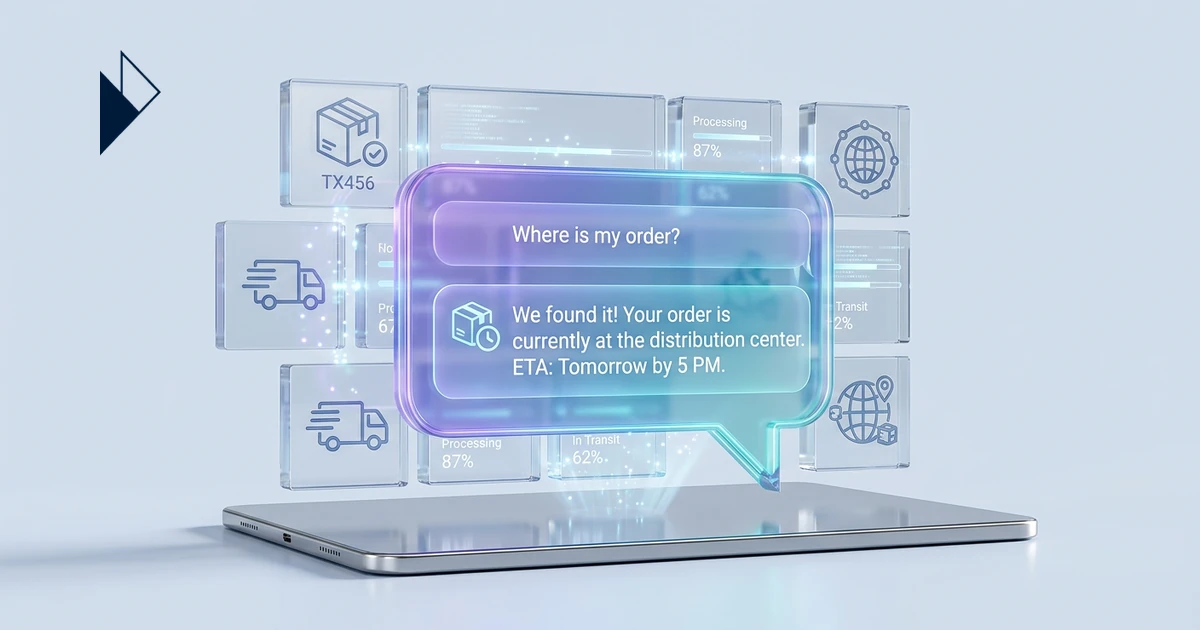
Ecommerce Conversational Commerce: Answering WISMO Inside the Chat
Stop WISMO from draining your margins. See how AI-driven chat turns delivery anxiety into scalable brand loyalty.
Aug 18, 2026
Parcel Perform
Ecommerce AI Returns Management: Cutting Reverse-Logistics Cost with Prediction
Cut reverse logistics costs with e-commerce AI returns management. Turn return data into margin protection and profit.
Aug 17, 2026
Parcel Perform
Ecommerce AI Personalization: Using Post-Purchase Behavior to Tailor Experience
Turn post-purchase behavior into a retention engine. See how AI personalization drives loyalty and cuts WISMO.
Aug 14, 2026
Parcel Perform