

Logistics KPIs that every Logistics Manager should track
Aug 03, 2021
What are logistics KPIs?
Logistics key performance indicators (KPIs) are performance metrics that allow you to track, visualize and enhance your logistics processes.
When you use KPIs to evaluate performance, you can be confident that you're consistently comparing your company's performance to a fixed standard. This makes variations evident right away, allowing you to adjust swiftly if performance starts to deteriorate.
KPIs also aid in maintaining consistent customer experience, in addition to an internal motivation to develop and compete. This is especially true in any firm where service level agreements (SLAs) are involved between two parties.
This article highlights the main logistics KPIs that logistics managers should consider in order to streamline and optimize their business operations and supply chain. Based on your team’s goals and areas of focus, you may find a combination of these KPIs useful to ultimately aid in making informed business decisions.
1. Order Fulfilment KPIs
Order fulfilment KPIs are centered on the processing of orders and returns, which are critical for reverse logistics. These metrics should be evaluated the moment an order is placed.
It is important that your team is informed of how your carriers/shipments are performing and if delivery hiccups are being handled promptly. Customers value quick and smooth shipments. This has a strong impact on repeat purchases.
What KPIs to track:

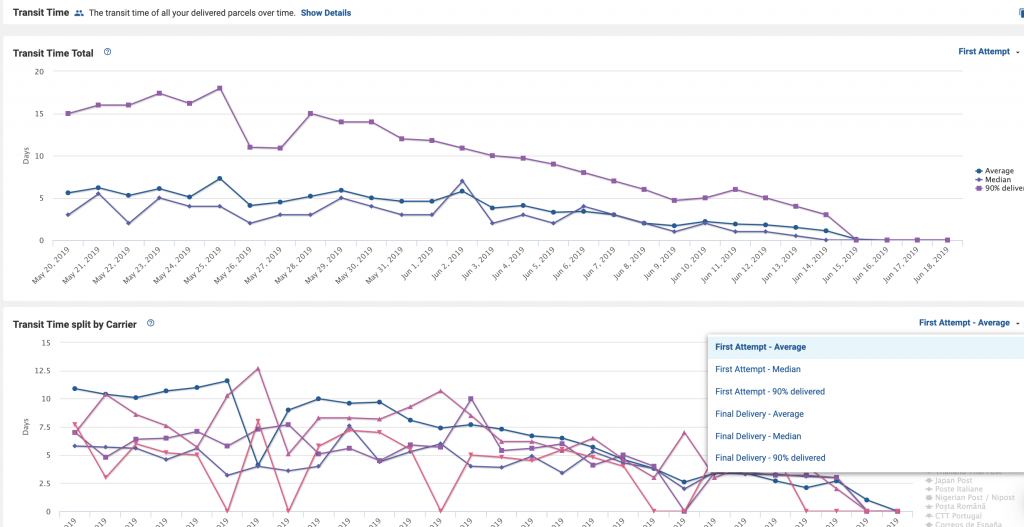
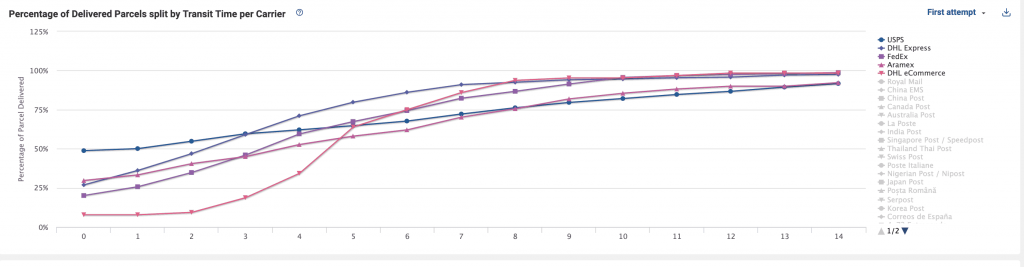
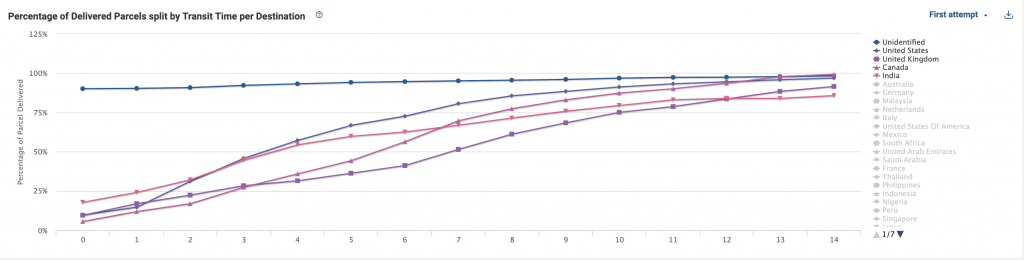
1) Transit Times: Track how fast your shipments/parcels are being delivered to your customers. Analyzing the amount of time your parcels take to be delivered enables your logistics team to improve business operations and overall customer satisfaction.
Key question addressed: Are my shipments being delivered by my carriers successfully and on time?
This can be done by tracking transit times via assessing carrier performance over time by:
Carrier
Destination
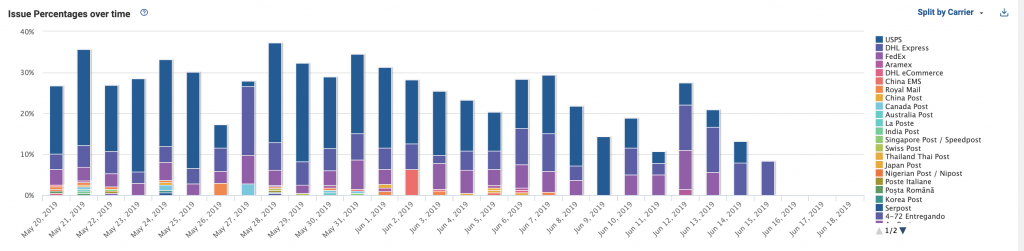
2) Perfect Order: This measures the number of orders shipped without any delivery issues (damage, delays or inaccuracies). This metric is another logistics KPI that targets customer satisfaction.
This is critical for logistics managers who want to analyze delivery patterns and identify the following concerns:
Carriers with the highest/lowest percentage of delivery issues across a specific duration or time period
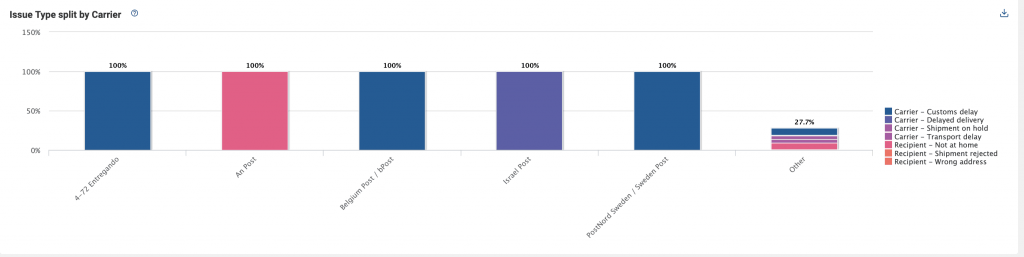
Types of delivery issues your carriers are experiencing
Detailed analysis of specific delivery issues your carriers face.
Key question addressed: Are my carriers performing up to proposed standards/expectations? What are the shipment/delivery parcel issues that my carriers/customers are experiencing?
This can be done via 2 metrics:
Issue Percentages over time
Issue type split by Carrier
3) Delivery Count: This refers to the number of shipments delivered in a given time period. This KPI helps logistics managers better utilize their resources and achieve their financial targets.
Key questions addressed: What is the total number of shipments? Across different carriers? Is my team utilizing my carriers effectively and efficiently?
It is crucial to have clear visibility of overall distribution of your shipment load across different carriers as it allows your team to plan accurately and provide your customers with a satisfactory delivery experience.
This KPI allows you to compare efficiency against your negotiated carrier rates and Service Level Agreements (SLAs) and can be tracked via:
Number of deliveries per day/week/month of first track event
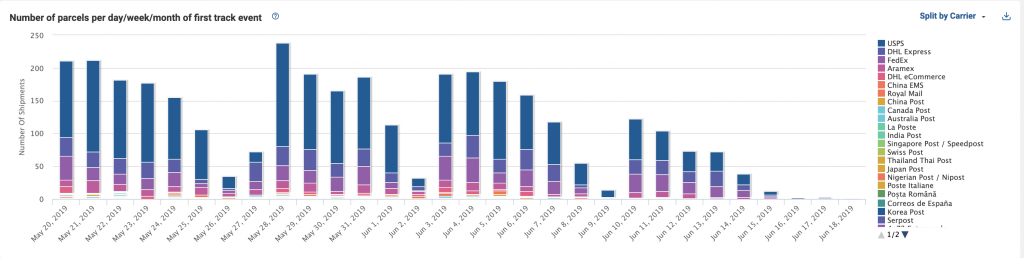
Number of deliveries made, split by carrier, status or destination
Having control over your logistics data allows for more cross-functional efficiency. Knowing where your shipments are being delivered to and where your customers are placing their orders from also allows you to identify actual locations of your target audience or user segment.
2. Transport Management KPIs
These KPIs measure how efficient your products are moving through the supply chain and enhance the flow of your business operations and processes. Essentially, these KPIs aid in building acceptable practices and relationships with other partners involved in your supply chain.
What KPI to track:
1) Lead Time: This refers to the time it takes for a customer to receive their shipment the moment their order has been placed. This allows logistics managers to track any possible bottlenecks in the supply chain.
It is critical to analyze this on a consistent basis to track how well your carriers are performing and resolve supply chain problems before they draw a significant impact on your end consumer.
Key questions addressed: Which carrier has the fastest transit time for a specific destination? What is my average transit time by destination? What’s the percentage of delivered shipments by carrier or destination?
There are 2 ways to track and analyze this:
Percentage of Delivered Parcels split by Transit Time per Carrier:
Percentage of delivered parcels split by target destination:
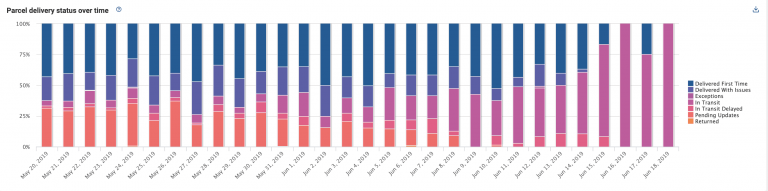
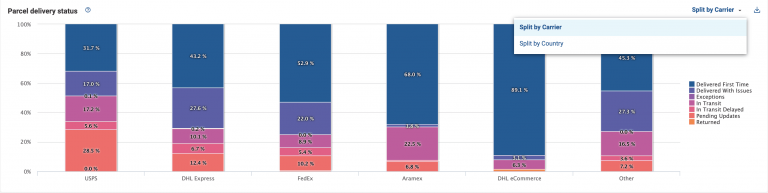
2) Productivity: This refers to how well your carriers are performing in terms of delivery fulfilment. Measuring and understanding this metric ensures that your carriers are delivering your shipments on time.
This is an important metric to track as it allows you to identify the amount of your delivered parcels that face delivery issues and the number of issues that have been solved.
Moreover, this also allows your team to track if these parcels were returned to the sender and identify any significant relationships between shipment delays and the time period of the year (eg. peak holiday season).
Key questions addressed: Are my shipments being delivered punctually and safely? Are my deliveries being completed by my carriers efficiently? What type of delivery issues and processes are my carriers facing?
Track your logistics carrier’s productivity through an an in-depth analysis of Shipment delivery status across:
Time
Trade lanes
3. Bonus: Track your Carrier's SLA performance
With the help of Parcel Perform, logistics managers can now track how well your carriers have kept up with your service-level agreement (SLAs) through reports in the Logistics Intelligence platform.
Some logistics metrics and KPIs covered in our comprehensive SLA reports:
Compliance overview:
A percentage breakdown of the parcels tracked and whether they comply with the SLA requirements.
Compliance by carrier:
Breach/Comply metrics of all parcels tracked, broken down by carrier. Use this report to quickly determine which carrier is falling short of SLA expectations for follow up action.
Breaches by day:
A summary graph of the number of breaches by week and the Breach-Comply percentage of all parcels tracked in that timeframe
Issues causing breaches:
A review of all the issues which lead to the parcel being classified as breached.
Interested to know more about our Logistics Intelligence platform and its features?
With Parcel Perform, logistics managers enjoy seamless integration and automated analysis of logistics performance across carriers for better business results. Speak to our team to find out how you can seamlessly integrate, standardize, and analyze all your logistics data on one single platform.
You might also like

How Logistics Data Drives Conversational Commerce Sales
Turn AI chatbots into revenue drivers. See how real-time logistics data powers high-converting conversational commerce.
Aug 21, 2026
Parcel Perform
How AI Delivery Prediction Cuts WISMO Tickets Before They Happen
Stop WISMO tickets before they start. See how AI delivery prediction cuts support costs and protects margins. — Read on
Aug 19, 2026
Parcel Perform
Ecommerce Conversational Commerce: Answering WISMO Inside the Chat
Stop WISMO from draining your margins. See how AI-driven chat turns delivery anxiety into scalable brand loyalty.
Aug 18, 2026
Parcel Perform