

The Delivery Landscape in Germany from Q1/2024 - Q1/2025
Germany’s e-commerce market is one of the most advanced in Europe, and it’s moving faster than ever. In 2024 alone, Germany’s B2C e-commerce market generated €88.3 billion, with online marketplaces like Amazon.de accounting for 55% of total sales. That kind of volume has raised the bar for logistics providers. Delivery isn’t just about getting the job done anymore. It’s about doing it smarter, cleaner, and faster. AI-driven commerce has moved delivery performance from the background to the center stage.
Furthermore, AI-powered shopping tools recommend retailers based on their proven delivery track record, but not their ad spend. It’s no longer enough to have a good product and a big budget. If your delivery isn’t consistent, transparent, and measurable, you risk getting pushed aside by shoppers and algorithms alike. Retailers and e-commerce logistics providers in Germany are now using AI tools like predictive analytics, chatbots, and real-time tracking to improve delivery experiences and meet rising customer expectations.
In another edition of our “E-Commerce Delivery Landscape” series, we take a look at how Germany’s logistics landscape has evolved from Q1 2024 through Q1 2025. We will also examine how AI commerce has redefined what “good delivery” means, and why your logistics setup is now one of your strongest signals to both shoppers and algorithms. As AI Commerce pushes delivery to the top of the agenda, one thing is clear – in Germany, your logistics isn’t hidden backstage anymore, it’s now the main act.
From E-Commerce to AI Commerce: A Shift Accelerating
The way people shop in Germany is changing fast. While it took traditional e-commerce nearly 20 years to become a major part of retail, AI Commerce is on track to reach 20% market share in just 5 years. That’s because AI tools are now helping shoppers make smarter, faster decisions. These AI tools are comparing not just products and prices, but also how reliable a brand’s delivery is.
What’s more, human-driven web traffic is going down, while AI-driven traffic is rising sharply. In 2024, 51% of global retail web traffic came from AI-powered bots, surpassing human-generated traffic. During the same year, 46% of German e-commerce purchases were made on tablets or mobile devices, often with help from AI tools like virtual assistants and personalized recommendations. This shift means that AI, not just people, is deciding which brands get seen.
Additionally, German shoppers are becoming more selective. They now treat delivery reliability as just as important as product quality and price. For retailers and e-commerce logistics providers, this means that delivery performance is no longer just a service, it’s often the deciding factor. To stay competitive in this new landscape, German brands must deliver on all three pillars: great products, fair prices, and reliable delivery.
Germany Delivery in Data: Q1 2024 – Q1 2025
To see how AI is reshaping delivery in Germany, we need to look at the numbers. Between Q1 2024 and Q1 2025, delivery performance showed both strengths and warning signs. While some areas improved, others revealed growing pressure, especially as AI tools began tracking every delay, missed attempt, and pickup pattern. Let’s break it down.
Transit Time: Still Fast, But Holiday Pressure Shows
Germany maintained impressively short transit times, averaging between 1.31 and 1.47 days. The fastest quarter was Q1 2024 (1.31 days), while Q4 2024 saw a slight slowdown (1.47 days)—likely due to Black Friday, Cyber Monday, and holiday shopping peaks. In addition, AI-powered route planning helped keep delivery times stable overall, but seasonal surges still stretched capacity. The key takeaway is that AI can smooth the ride, but peak periods still need extra planning.
First-Attempt Delivery Success: A Sharp Decline
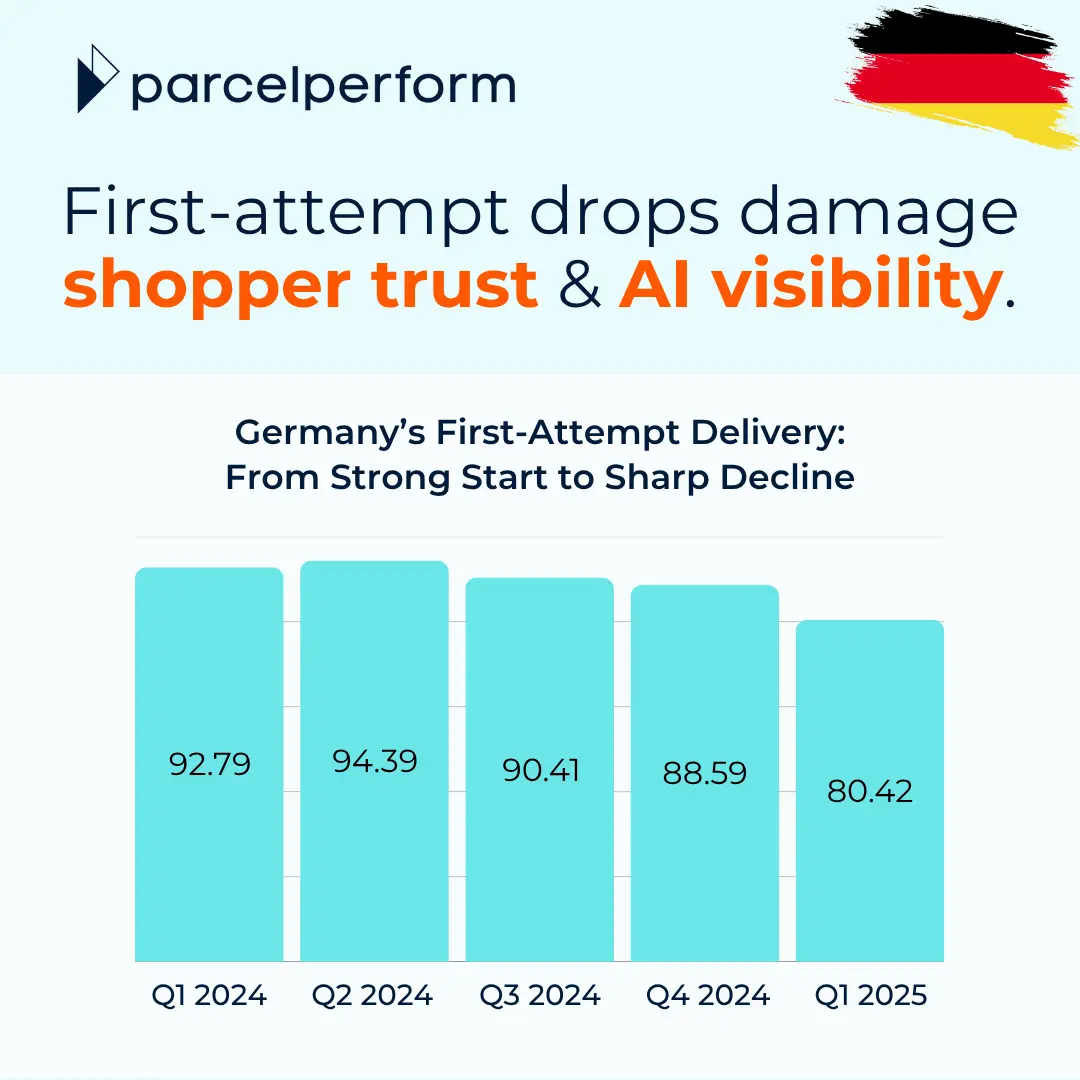
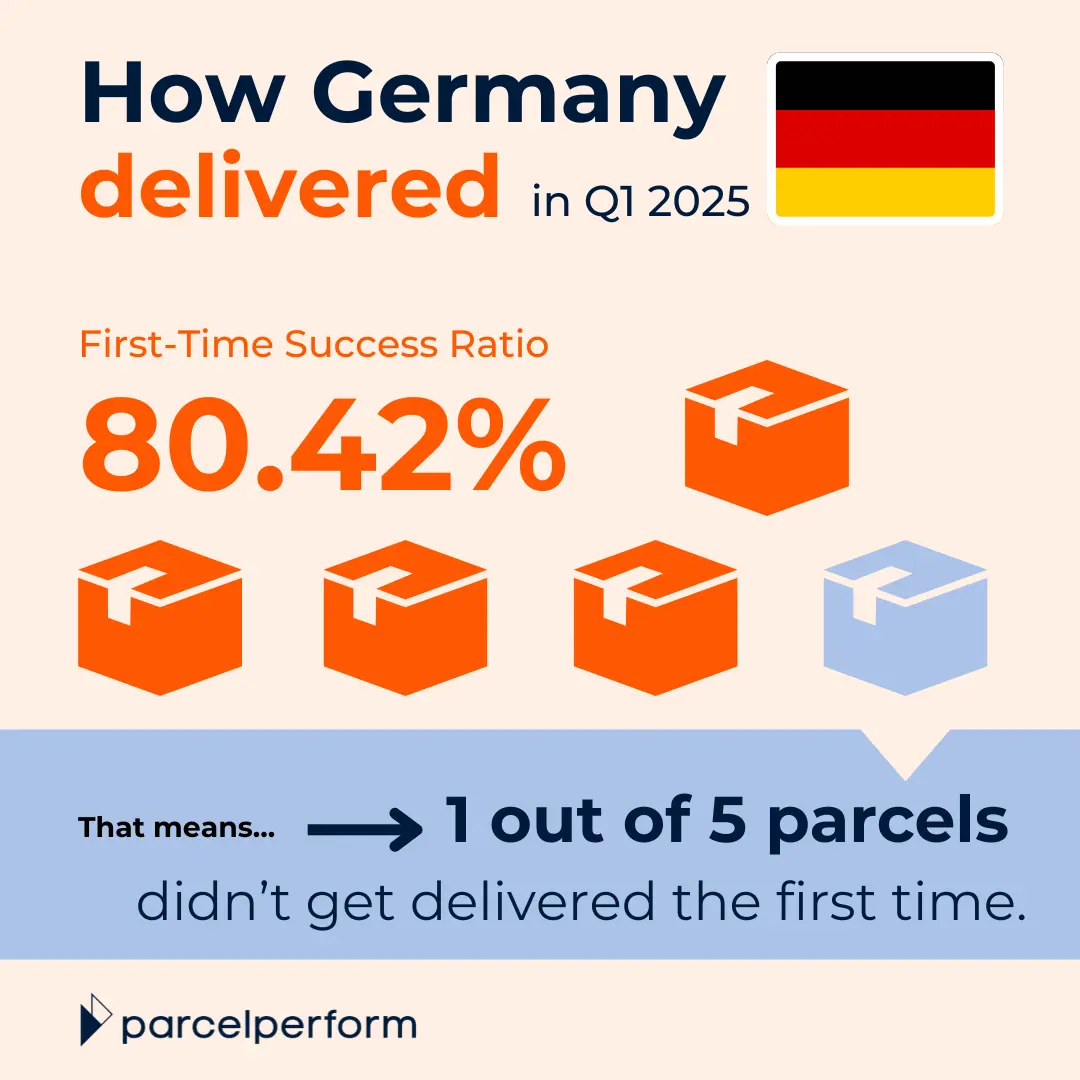
Furthermore, the first-attempt delivery success ratio dropped significantly from 92.79% in Q1 2024 to just 80.42% in Q1 2025. That’s a clear sign of rising challenges in reaching customers on the first try. Possible reasons for this continuous decline include missed delivery windows, incorrect addresses, or a lack of flexible delivery options. AI tools that send real-time updates or allow customers to reschedule deliveries could help reverse this trend.
On-Time Delivery Ratio: A Bright Spot
Despite other challenges, on-time delivery remained strong, climbing from 96.02% in Q1 2024 to 97.42% in Q1 2025. This shows that many German retailers and logistics providers are using accurate Estimated Delivery Dates (EDDs) and AI-powered alerts to keep promises. Even with weather disruptions or last-mile delays, AI helped teams stay on track and protect customer trust.
Issue Ratio: Still High, But Stable
Issue ratios stayed elevated, ranging from 8.17% to 9.75%. The highest point was Q1 2024, with a slight dip in mid-year, then rising again in Q4, likely due to volume spikes and carrier strain. AI monitoring can help by spotting patterns early, whether it is carrier delays due to strike action, failed address checks, or system errors, and guiding teams to act before problems grow.
Dwell Time Ratio: Quiet Progress
Dwell time—how quickly customers collect parcels from pickup points—improved steadily, from 51.23% in Q1 2024 to 59.08% in Q1 2025. That means more shoppers are picking up their parcels within 24 hours. This could be thanks to better notifications, smarter locker placement, and AI-led pickup point management. It’s a small but important win for delivery efficiency.
Collection Point Usage: Holding Steady
Collection point usage stayed fairly consistent, hovering around 9% across all quarters. While not a dramatic shift, it shows that pickup points remain a reliable option for many German shoppers, especially during busy seasons like Q4. To boost this further, retailers may need to offer more flexible pickup options and improve communication around collection times and locations.
Together, these numbers show that Germany’s delivery landscape is evolving, but not without friction. AI is helping teams stay ahead, but success depends on how well businesses respond to what the data is telling them.
Fixing What’s Broken: AI Decision Intelligence in Action
Germany’s delivery data from 2024 to 2025 revealed some clear trouble spots. First-attempt delivery success dropped sharply, meaning more parcels weren’t delivered on the first try. Dwell time ratios kept rising, showing that many customers weren’t picking up their parcels quickly.
Likewise, issue ratios stayed high, pointing to ongoing problems like delays, failed handovers, or system errors. This is where AI Decision Intelligence steps in. This effective AI solution is built to help retailers and logistics teams fix these problems fast before they affect customer experience or damage brand visibility. Here’s how it works:
AI Data Monitoring
AI Decision Intelligence watches over more than 150 delivery metrics, 24/7, round-the-clock. It checks everything from transit times to pickup delays, and flags anything unusual right away. Whether it’s a carrier delay or a problem at a collection point, nothing slips through the cracks.
Daily AI Summaries
Instead of digging through endless reports, your team gets a clear daily summary. It shows what’s working, what’s not, and what to fix first. This helps teams focus on the most urgent issues, like a sudden drop in first-attempt success, without wasting time on guesswork.
AI Recommendations
Once the AI Decision Intelligence finds a problem, it doesn’t stop there. The solution gives practical suggestions to fix it, such as switching carriers, adjusting delivery windows, or sending better pickup reminders. These tips help retailers and logistics teams improve delivery operations and performance in real time. Thus, keeping delivery metrics moving in the right direction.
With AI Decision Intelligence, German retailers can turn delivery data into action, and action into better results. Want to explore the full feature set? Check out the official product page here.
The New Mandate: Delivering for AI-Driven Germany
In today’s AI-powered shopping era, your delivery performance is no longer hidden behind the scenes, it’s front and center. Both shoppers and AI systems now use your delivery track record to decide whether your brand is shown, trusted, or skipped.
That means every missed delivery, failed first attempt, or uncollected parcel becomes data. This data will help shape your visibility online. If your logistics performance is weak, your brand could be pushed down or even left out of AI recommendations. Conversely, if you’re consistent and reliable, you’ll stand out where it matters most.
Retailers and Carriers Need Real-Time, Measurable, Transparent Delivery System
To stay competitive, German retailers and logistics providers need to move beyond basic shipping. Success now requires a delivery system that’s fast, visible, and built on reliable data. It’s not enough to ship quickly, you need to prove that you can do it consistently and clearly, every time. Here’s what the new delivery standard looks like today:
Live visibility into every delivery step, from warehouse to doorstep.
AI-powered alerts that catch and fix problems fast.
Accurate Estimated Delivery Dates (EDDs) at checkout, with minimal surprises.
Clear delivery performance metrics that build shopper trust.
These aren’t just upgrades, they’re must-haves in a world where delivery data helps your brand to be discovered.
Logistics Is Now Your Loudest Brand Signal
In Germany’s AI Commerce world, delivery isn’t just something you do, it’s how your brand gets discovered, trusted, and chosen. The strength of your logistics speaks louder than any campaign, and your ability to deliver reliably is now a competitive edge, not a backend task. Therefore, the better your logistics operations, the stronger your brand signal to both shoppers and AI agents.
Final Thoughts – Reliable Delivery with AI Decision Intelligence Is the New Brand Advantage
In conclusion, German retailers are stepping into a new phase of e-commerce, one where delivery performance shapes brand visibility. As we’ve seen from Q1 2024 to Q1 2025, delivery data is now front and center in AI Commerce. It’s no longer enough to move parcels quickly. Brands, retailers, and logistics carriers must also deliver with consistency, accuracy, and transparency. Each delivery attempt, every pickup delay, and all issue resolutions feed into how AI platforms assess and recommend your business.
To compete in this new AI commerce landscape, logistics must evolve into an AI-ready, data-driven operation. The most successful brands will be those that are measurable, dependable, and easy for AI systems to trust. Delivery is no longer just fulfillment, it’s a brand signal, a performance score, and a competitive advantage rolled into one. Ready to see how AI Decision Intelligence can transform your delivery strategy? Book a demo with Parcel Perform and stay ahead in AI Commerce.
Germany Delivery in the Age of AI Commerce: Your Questions Answered
1. Why does delivery now shape brand discoverability?
AI shopping tools don’t just look at your products, they look at how well you deliver. They track metrics like on-time rates, delivery success, and issue volumes. If your delivery data shows that you’re reliable, AI is more likely to recommend your brand to shoppers. In Germany’s AI Commerce world, your delivery track record is now part of your brand’s visibility.
2. What’s the most critical delivery metric?
Two things matter most. These include accurate Estimated Delivery Dates (EDDs) and first-attempt delivery success. EDDs help AI systems match your promises to real results. If you miss them often, your brand may stop showing up in search or recommendation results. Similarly, if you fail to deliver on the first try, it signals poor customer experience. Both metrics are key to building trust with shoppers and with AI agents.
3. How does AI Decision Intelligence help?
AI Decision Intelligence makes it easier to stay ahead. It monitors over 150 delivery signals in real time, highlights the most urgent problems each day, and gives clear suggestions regarding how to fix them. Whether it’s a drop in success rates or a spike in pickup delays, AI helps your team act fast and improve performance before it affects your customers or your discoverability.
You might also like

Why Predictive Logistics Beats Real-Time Dashboards for Ecommerce Ops
Stop reacting to supply chain delays. See how predictive logistics lowers costs and protects e-commerce margins.
Sep 04, 2026
Parcel Perform
Stop Delivery Delays: Boost Loyalty with Predictive Logistics
Stop delivery delays before they reach the customer. Use predictive logistics to protect margins and boost loyalty.
Sep 03, 2026
Parcel Perform
Predictive Logistics: How AI Turns Carrier History into Forward-Looking Decisions
Stop reacting to delays. See how AI turns historical carrier data into forward-looking logistics decisions. — Read on fo
Sep 02, 2026
Parcel Perform