

The Rising Importance of Logistics Data Management for LSPs
With the COVID-19 pandemic, increasing shifts to e-commerce and pressure on the global transportation network has resulted in a rise in demand for consistent, swift and affordable delivery. Visibility and convenience in the delivery journey are now key purchase decisions. Customers want to know exactly where and when their deliveries will be fulfilled. This has made it especially imperative for logistics service providers (LSPs) to leverage a logistics data management platform that provides full visibility into their business operations.
To prepare for the rapid surge in volumes and increasing customer expectations, logistics companies need to consider the benefits of logistics data analysis. The transparency offered will allow LSPs to stay ahead of the competition. They will be able to provide a better customer experience, optimize their operational efficiency and boost sustainability efforts. It also provides much greater traceability and predictability (not to mention cheaper costs).
Logistics data collection and utilization challenge for LSPs
Logistics Service Providers (LSPs) generate large volumes of data that serve as an important source of business intelligence and offer key insights into operational performance and efficiency. But large volumes of data also add complexity and LSPs are faced with the challenge of seamless data integration, aggregation and standardization.
Lack of access to standardized data
LSPs do not always have full control and first-hand data for the entire delivery process. They often outsource delivery services to other companies to fulfill last-mile deliveries and in return, receive incomplete, unstandardized data from various sources and in different formats that are hard to standardize across events and languages.
Lack of data aggregation and integration capabilities
Where data is available, aggregating it poses a major challenge. Multiple steps are required to aggregate data such as integrating it into a single platform, translating and standardizing data, and managing update latencies. This is laborious for LSPs to accomplish, especially when it is not their core business competency. It is painstaking and requires expertise and technology to generate meaningful insights.
Lack of tools for data visualization
LSPs require their data to be aggregated in a single intuitive platform that provides meaningful visualization of shipment information and carrier performance. However, heavy investment in IT resources and data infrastructures is required when analyzing logistics data, calculating SLAs and measuring real-time performance.
Some LSPs lack data infrastructures or their IT teams have a backlog in the current infrastructure. This makes it increasingly difficult to execute data analysis without leveraging a tech partner.
How can Parcel Perform help LSPs?
1. Tracking of outsourced delivery services
Global parcel shipping volume amounted to approximately 103 billion parcels in 2019. This volume is projected to more than double and reach 262 billion parcels shipped in 2026 (Statista) Numerous delivery handoffs between postal and commercial logistics partners make cross border delivery data and tracking more complicated. Parcel Perform offers automated normalization of tracking events across multiple event sources and 700+ carriers for transparency. Logistics companies get an integrated data feed combined with their own events and real-time visibility of shipment whereabouts to identify shipment fulfilment issues - all in one platform. With cross border deliveries, we standardize data in over 30+ languages, providing easy and flexible communication. We also map the timestamps of respective events to a timezone based on the shipment’s destination country providing granular visibility. As Parcel Perform is a carrier-independent platform, LSPs no longer have to rely on outsourcing partner data to identify delivery issues or delays in cross-border shipments. In the unlikely scenario that logistics companies use a carrier that is not covered, it only takes us 14 days to onboard them without any complications. For tracking data integration, our platform supports API, EDI, SFTP file transfer, webhooks and over 20 other integration options.
With our complete coverage of all carrier and data integration needs, logistics companies will be equipped to drive their growth across parcel volumes, operations and countries.
2. Leveraging logistics data to build a customised delivery experience for clients
70% of consumers ranked the ability to track orders as a top priority when purchasing products online. In addition to having full visibility to your logistics data, timely communication of delivery status to clients and end consumers can be a game-changer for LSPs. By layering the shipment data with customer information, LSPs can implement customisable branded tracking pages. Parcel Perform’s branded tracking page serves as a definitive white-label solution for LSPs and their clients. As an internal tool, it allows them to incorporate their business’s unique branding to enhance their delivery services without investing heavily in in-house developments, thus focusing on their business’s core competency.
What’s more, they can also upsell these tracking pages to their merchants or end-consumers as an add on service. LSPs will also gain a competitive advantage by offering customisable tracking pages to their customers, allowing them to identify and track shipment volumes that they do not control.
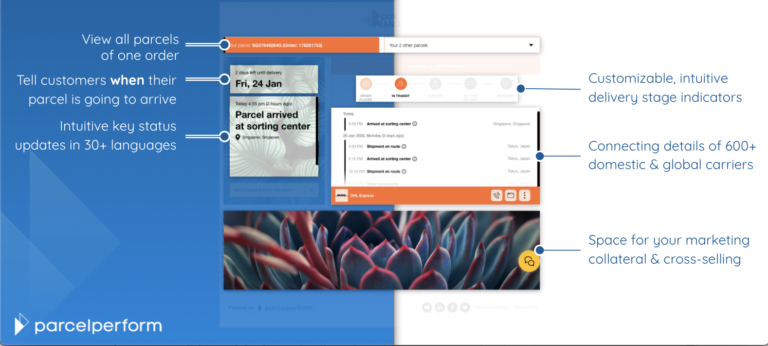
The tracking page displays key shipment tracking information and provides LSPs and their merchants the ability to:
Access the most recent updates on their shipments at a glance.
Access delivery status updates and locations in over 30 languages.
View all shipments/deliveries associated with a specific order number.
Identify when their parcels will be delivered with the Date of Arrival Predictions add-on.
LSPs working on time-sensitive shipments and various locations can be assured that their customers will be informed and engaged throughout their delivery journey.
3. Real-time analysis and visualization of carrier performance
LSPs are often required to fulfil their clients’ reporting requirements that are beyond their core competency. They are asked to track and compare real-time delivery performance to promised service levels - an essential yet challenging process for logistics managers. Hence, implementing an easy-to-understand data visualization tool eases the burden of manual and complex data reporting. LSPs can focus on making informed decisions to improve internal supply chain performance and satisfy client expectations.
Parcel Perform gives LSPs full visibility on complex logistics data with detailed Logistics Reports on all their carriers’ performance. Our Logistics Intelligence tool strives to meet all of your reporting or analysis needs:
Analyze parcel delivery issues that have occurred in the past 12 months and examine delivery trends across the month to solve the following challenges:
Delivery issues status
Types of delivery issues encountered
Carriers facing delivery issues
Analyze correlations or other data trends by comparing the total amount of pending parcels in a popular trade route to parcels with issues.
Conduct micro and macro logistics analysis simultaneously. Within one report, you may view your company's quarterly logistics performance and evaluate each carrier's performance across a critical cross-border commerce route.
For instance, our Parcel Delivery Status report helps LSPs analyze the delivery status of all their shipments over a specific time. This report works well alongside the Delivered Parcel report and provides a singular view of all delivered shipments split by carrier and country.
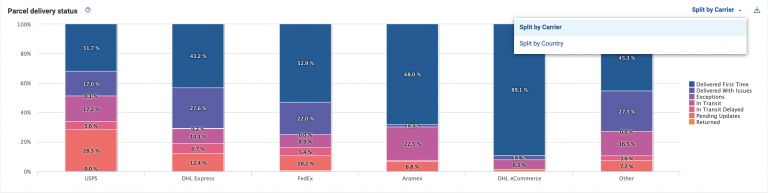
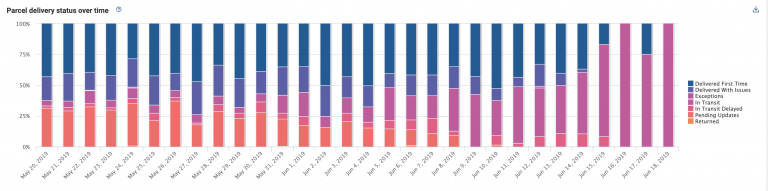
With real-time visibility on issues aggregated at the parcel level, these reports can be compared directly to each carrier’s Service Level Agreement (SLA). Any issues found in breach of the SLA can be reported back to the carriers to be quickly and decisively addressed. Parcel Perform offers fully customizable SLA metrics to deliver real-time calculations on SLA compliance on specific shipments, simplifying tracking processes and reducing time spent in identifying issues. We automatically track shipment performance and evaluate this based on the terms of the specific SLA agreement with the carrier.
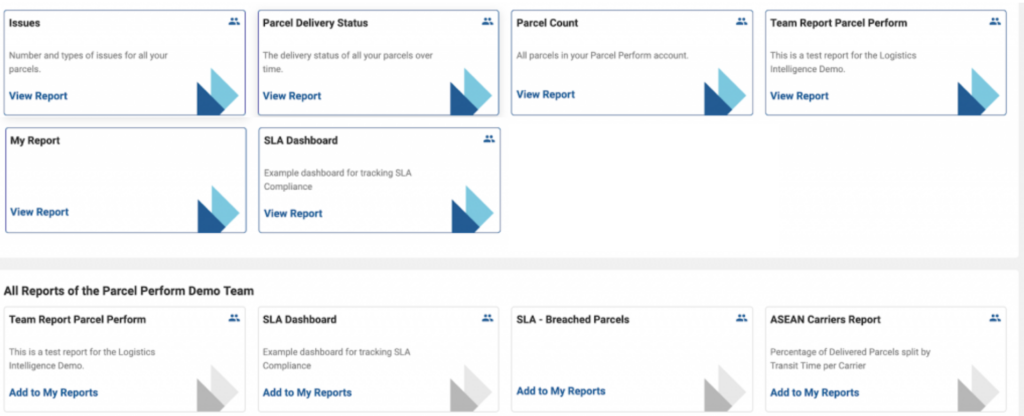
Examples of some key logistics metrics included in our SLA reports are:
Compliance overview: A percentage breakdown of the parcels tracked and whether they comply with the SLA requirements.
Compliance by carrier: Breach/Comply metrics of all parcels tracked, broken down by carrier. Use this report to quickly determine which carrier is falling short of SLA expectations for follow up action.
Breaches by day: A summary graph of the number of breaches by week and the Breach-Comply percentage of all parcels tracked in that timeframe
Issues causing breaches: A review of all the issues which lead to the shipment being classified as breached.
4. Boost sustainability efforts
Empty miles are one of the biggest sources of waste in supply chains. Hence, sustainability will remain a key focus area of logistics. LSPs must track metrics like the rate of re-delivery and how their carriers are delivering these shipments to reduce carbon emission. Developed in partnership with Amazon Web Services Machine Learning Solution Lab, Parcel Perform’s Date of Arrival Predictions engine This is integrated seamlessly within our Premium Branded Tracking page.
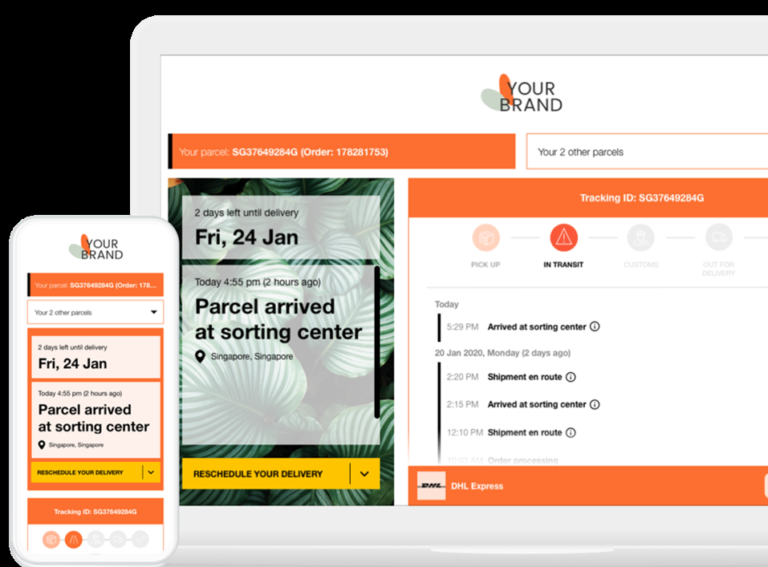

LSPs can update customers of their delivery status throughout their delivery journey. In addition, our Notification Centre allows LSPs to send SMS delivery notifications to alert consumers on when their shipments are arriving soon. LSPs can foresee and manage potential redelivery circumstances, thereby reducing carbon footprint.
Start generating insights from your logistics data
With Parcel Perform, logistics service providers enjoy seamless integration and automated analysis of logistics performance for better business results. Speak to our team to find out how you can seamlessly integrate, standardize, and analyze all your logistics data in one single platform.
You might also like

Why Predictive Logistics Beats Real-Time Dashboards for Ecommerce Ops
Stop reacting to supply chain delays. See how predictive logistics lowers costs and protects e-commerce margins.
Sep 04, 2026
Parcel Perform
Stop Delivery Delays: Boost Loyalty with Predictive Logistics
Stop delivery delays before they reach the customer. Use predictive logistics to protect margins and boost loyalty.
Sep 03, 2026
Parcel Perform
Predictive Logistics: How AI Turns Carrier History into Forward-Looking Decisions
Stop reacting to delays. See how AI turns historical carrier data into forward-looking logistics decisions. — Read on fo
Sep 02, 2026
Parcel Perform