

AI Commerce is Here: How Your E-commerce Returns Strategy Defines Your AI Visibility
Sep 03, 2025
For most e-commerce leaders, the returns process is a familiar headache. It's often viewed as a complex and costly operational function, with a recent report from the National Retail Federation estimating the total cost of returns for the U.S. retail industry at over $743 billion. But in the new era of AI Commerce, your returns policy has taken on a powerful, hidden role. It is no longer just a back-office function. It has become a public-facing, machine-readable statement about your brand’s confidence, reliability, and trustworthiness.
This shift is happening now. The AI-driven retail market is not a distant concept; it's a rapidly expanding reality, with projections from firms like McKinsey suggesting that generative AI could add between $2.6 trillion to $4.4 trillion in value annually across industries, with retail seeing a significant impact. While your teams focus on the forward journey, your reverse logistics are quietly shaping your AI Visibility. AI shopping agents, the new data-driven gatekeepers of retail, are designed to be ruthlessly risk-averse.
A difficult or unclear returns process is one of the most significant red flags they can detect. Conversely, a seamless Returns Experience is a powerful Trust Signal, proving your brand is a safe choice. This is critical, as research from the National Retail Federation highlights that the vast majority of consumers review a brand's return policy before committing to a purchase, making a seamless process a key driver for both initial conversion and long-term loyalty.
The AI Agent as a Risk Assessor: Why Returns Matter More Than Ever
To understand why your returns management policy is so influential, you have to understand the core motivation of the AI shopper: to ensure a successful, risk-free outcome for its human user. An AI agent’s reputation is on the line with every recommendation. As high-level analysis from firms like Gartner suggests, these tools are designed to weigh evidence and provide the most reliable options.
This isn't a future problem. A Salesforce report highlights that a significant percentage of consumers, especially younger demographics, are already using generative AI for product discovery and research. Your returns process provides a rich dataset for this risk assessment. A convoluted, costly, or slow process represents a significant potential burden for the user.
In fact, research from the Baymard Institute shows that an unsatisfactory returns policy is a direct contributor to cart abandonment. An AI will logically favor merchants who eliminate that risk. Your policy and its execution are no longer just a matter of customer service; they are a verifiable testament to your customer experience, and AI agents are watching.
Decoding the Trust Signals in Your Returns Process
Every step of your returns journey generates a positive or negative Trust Signal that contributes to your overall AI Visibility. Optimizing these signals is key to becoming a preferred brand in the age of AI.
From Hidden Policies to Radical Transparency
Negative Signal: A confusing, hard-to-find policy buried in the footer or full of jargon is a major red flag. It’s a signal of low transparency. For an AI, this indicates a brand that is not confident in its products, immediately increasing its risk profile.
Positive Signal: A clear, accessible, self-service experience sends a powerful message of trust and efficiency. A seamless Returns Experience powered by a self-service portal makes the process easy, which drastically reduces "Where Is My Return?" (WISMR) inquiries—costly support tickets that serve as clear negative Trust Signals.
From Painful Waits to Proactive Communication
Negative Signal: When customers wait weeks for a refund, they leave a trail of negative sentiment in reviews and social media posts. AI agents can easily parse this unstructured data, flagging your brand as unreliable. The operational inefficiency of a slow process becomes a public-facing liability that directly harms your AI Visibility.
Positive Signal: Proactive communication throughout the return journey builds immense trust. By providing tracking and status updates for the return shipment, you manage expectations and reduce the need for customers to contact support, improving the overall post-purchase experience.
From Simple Refunds to Smart Revenue Recovery
Negative Signal: A process that only offers a full refund can be a missed opportunity. It ends the customer relationship on a transactional, and often final, note. This can negatively impact customer lifetime value, a key metric for long-term brand health.
Positive Signal: Intelligently promoting exchanges or store credit does more than just recapture revenue from returns. It sends a powerful Trust Signal of brand confidence and boosts customer retention—another key metric that AI can evaluate.
The Shortcut: How to Make Returns a Trust-Generating Asset
Managing a world-class returns experience at scale is operationally complex. For many businesses, fragmented systems and manual processes make it impossible to deliver the seamless experience needed to generate positive Trust Signals.
This is where a unified, end-to-end platform provides an intelligent shortcut. Parcel Perform's Returns Experience is designed to transform this traditional cost center into a strategic asset for building AI Visibility.
Deploy a Self-Service Portal with Smart Revenue Recovery: Our integrated portal makes returns effortless for customers while intelligently promoting exchanges to recapture revenue. This creates the seamless experience that generates positive Trust Signals for both ease-of-use and brand confidence.
Automate Complex Policies to Ensure Speed and Reliability: Our flexible rules engine automates even the most intricate returns management policies. This eliminates manual workloads for your Customer Service Teams, ensuring refunds are processed quickly and reliably, leading to a proven reduction in WISMO contacts.
Protect Margins with AI-Driven Deterrence: To ensure the process is both customer-friendly and profitable, our platform uses AI Decision Intelligence to analyze return patterns, automatically flagging potential fraud and abuse to protect your bottom line.
Your returns process is no longer happening in the background. It is a live, public demonstration of your brand's character, and it is being evaluated. By transforming returns into a transparent, efficient, and customer-centric experience, you create one of the most powerful Trust Signals available.
Take control of your AI Visibility. Book a demo to learn how the Parcel Perform Returns Experience can turn your reverse logistics into a competitive advantage.
Frequently Asked Questions (FAQ)
1. How can an AI "know" if my returns process is easy or difficult?
An AI can infer the quality of your returns process from multiple data points. These include the clarity and accessibility of your policy on your website, customer reviews mentioning returns, the rate of "Where Is My Return?" (WISMR) inquiries, and the average time it takes to process a refund. A seamless process, often enabled by a self-service portal, generates positive data; a difficult one generates negative data.
2. What is a "WISMR" inquiry and how does it affect AI Visibility?
WISMR stands for "Where Is My Return?" It is a customer service inquiry about the status of a return or refund. High WISMR rates are a powerful negative Trust Signal. They indicate a lack of transparency and an inefficient process, which signals to a risk-averse AI agent that your brand may be unreliable and costly to deal with.
3. Does offering free returns automatically improve my Trust Signals?
While a free returns policy is a positive signal, the execution of the process is more important. A "free" return that is slow, confusing, and lacks communication can still generate negative Trust Signals through poor reviews and high support costs. A seamless, fast, and transparent Returns Experience is what truly builds trust with both humans and AI.
4. How does promoting exchanges over refunds impact AI Visibility?
Promoting exchanges sends a strong Trust Signal of brand confidence. It implies you are so sure of your product quality that you can help the customer find a better alternative. This contributes to higher customer lifetime value and signals to an AI that you are a brand customers want to stick with, making you a less risky recommendation.
5. Why can't I just write a good returns policy on my website? Why do I need a platform?
A written policy is a "claim." A seamless, fast, and transparent process is "verifiable evidence." AI agents are designed to prioritize evidence over claims. A platform like Parcel Perform ensures the execution of your returns management process matches the promise of your policy, creating the positive, real-world performance data needed to build strong AI Visibility.
You might also like
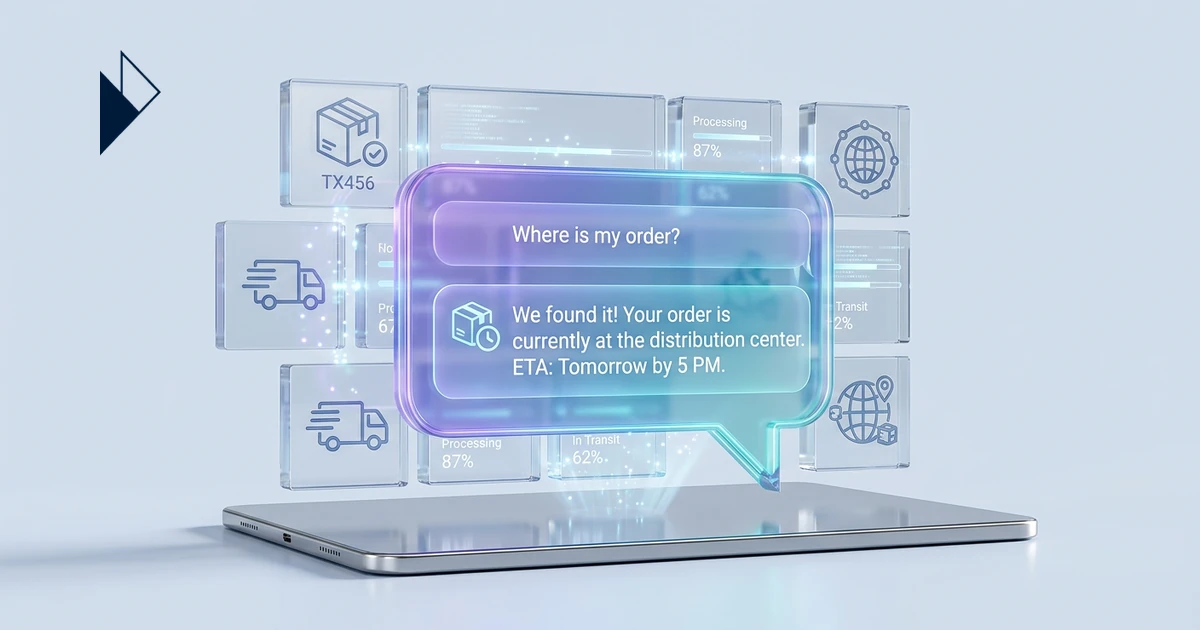
Ecommerce Conversational Commerce: Answering WISMO Inside the Chat
Stop WISMO from draining your margins. See how AI-driven chat turns delivery anxiety into scalable brand loyalty.
Aug 18, 2026
Parcel Perform
Ecommerce AI Returns Management: Cutting Reverse-Logistics Cost with Prediction
Cut reverse logistics costs with e-commerce AI returns management. Turn return data into margin protection and profit.
Aug 17, 2026
Parcel Perform
Ecommerce AI Personalization: Using Post-Purchase Behavior to Tailor Experience
Turn post-purchase behavior into a retention engine. See how AI personalization drives loyalty and cuts WISMO.
Aug 14, 2026
Parcel Perform