

Model Context Protocol for Ecommerce: Exposing Logistics Data to AI Agents
When an AI agent tries to track a delayed parcel, unstructured carrier data breaks the transaction. The Model Context Protocol (MCP) fixes this by translating chaotic logistics events into a standard format machines can read. By standardizing how the engine reads shipment events and delivery dates, MCP drives operational efficiency and reduces customer service costs.
The Rise of AI Agents in Agentic Commerce
Commerce is shifting toward systems where AI agents discover, compare, and purchase on behalf of shoppers. This shift requires machine-readable data at every stage of the funnel. Shoppers no longer rely solely on traditional search engines; they ask AI assistants to find products, verify stock, and confirm delivery timelines. 39% of consumers — and over half of Gen Z — are already using AI for product discovery. AI agents will soon manage the majority of customer interactions, altering how brands structure their operational data.
When an AI agent evaluates a brand, it looks for structured, reliable signals. If the agent cannot parse delivery timelines or return policies, it often recommends a competitor whose data is legible. The stakes for this visibility are high. AI search visitors convert at a 23x higher rate than traditional organic search visitors. Brands that structure their logistics data for AI ingestion capture this high-intent traffic, while those relying on unstructured text risk being filtered out of the agentic commerce layer.
Why Logistics Data is Critical for Effective AI Agents
AI agents require real-time logistics data to execute complex supply chain and customer service scenarios. A shopping assistant cannot confidently recommend a product for a time-sensitive purchase without reading an accurate Estimated Delivery Date (EDD). 23% of shoppers abandon carts due to slow delivery, making precise logistics data a primary conversion lever. If the agent cannot access this data, the transaction fails before checkout.
Beyond discovery, AI agents need logistics data to manage the post-purchase experience. When a customer asks an AI assistant, "Where is my order?", the agent must query the underlying logistics system. If the data is fragmented across multiple carriers or hidden behind legacy APIs, the agent hallucinates or defaults to a generic response. Exposing granular tracking events and shipment information directly to the agent ensures accurate, proactive issue resolution, preventing the inquiry from escalating to your support team.
Understanding the Model Context Protocol (MCP)
The Model Context Protocol (MCP) functions as an open standard to securely connect AI assistants to external tools, data sources, and services. The protocol provides a consistent interface for AI models to ingest context, replacing custom, fragile API integrations with a standardized framework. For e-commerce operations, MCP acts as the translation layer between complex logistics databases and the AI agents that need to read them.
Instead of building separate connectors for every new AI tool, engineering teams use MCP to expose their data once. The protocol defines how the AI agent requests information, how the system authenticates the request, and how the data is formatted in the response. This standardization allows retailers to safely expose inventory levels, carrier performance metrics, and real-time shipment tracking without risking data leakage or overwhelming their internal infrastructure.
The Interoperability Challenge: Bridging Data Gaps for AI
The primary barrier to agentic commerce is data fragmentation. Significant interoperability issues currently impede the direct combination of data from disparate sources, both within and across sectors. In logistics, this fragmentation is severe. A single global retailer might use dozens of carriers, each with its own status codes, update frequencies, and API structures. When an AI agent attempts to read this data, it encounters a chaotic mix of formats.
Standardization efforts like MCP provide a structural solution, but they require a clean data foundation to function. If the underlying data remains fragmented, exposing it via MCP simply feeds chaotic data to the AI faster. Retailers must first normalize their e-commerce logistics data — mapping thousands of unique carrier events into a single, standardized taxonomy — before presenting it to the protocol. Only then can AI agents reliably interpret the context and execute decisions.
How Exposed Logistics Data Drives Operational Efficiency and Cost Reduction
Providing AI agents with standardized logistics data yields immediate financial impact. AI-enabled distribution operations have the potential to achieve 5–20% logistics cost reduction and 20–30% inventory reduction. Much of this cost reduction stems from automating routine customer service tasks and optimizing carrier allocation based on real-time performance data.
In customer service, exposed logistics data directly targets WISMO (Where Is My Order) volume. When an AI agent has access to standardized tracking events and predictive delivery models, it can proactively notify customers of delays before they initiate a support ticket. This shift from reactive support to proactive automation reduces the burden on human agents, freeing human agents to handle complex exceptions and driving significant operational efficiency across the service organization.
Parcel Perform: Your Gateway to AI-Ready Logistics Data
To use MCP effectively, retailers need a data foundation built for scale. Parcel Perform processes 100bn+ parcel updates a year, standardizing data from 1,100+ global carrier integrations into 155+ harmonized event types. This normalization creates the exact structured context that AI agents require to function accurately.
Through robust API Integration, Parcel Perform exposes this rich logistics data to your internal systems and AI tools. The platform's Public API integration allows developers to retrieve detailed shipment information, including granular tracking events, expected delivery dates, and carrier references. By utilizing the shipment overview data, retailers can feed their AI agents a single, unified truth regarding every parcel in transit, regardless of the underlying carrier.
Empowering Your CX & Service Teams with Intelligent Automation
Parcel Perform's AI-first platform transforms how customer service teams operate. By exposing logistics data through the post-purchase experience, brands can automate complex support workflows. The platform's notifications engine uses this standardized data to trigger proactive updates, keeping customers informed and reducing inbound ticket volume.
For internal teams, the AI Navigator acts as a helpful assistant, capable of answering questions related to product features and platform data. CX agents use the AI Navigator to instantly locate specific shipments, check order statuses, and retrieve relevant information without manually parsing carrier websites. This intelligent automation accelerates resolution times and allows human agents to focus on high-value, complex customer interactions rather than routine tracking queries.
Real-World Impact: Streamlined Operations, Happier Customers
The combination of standardized data and AI accessibility drives measurable results for Parcel Perform clients. Intelligent analytics provide full-network and carrier SLA performance insights, allowing operations teams to identify bottlenecks and optimize their logistics networks. By analyzing reports and analysis, retailers can adjust their shipping strategies based on hard data rather than intuition.
When AI agents have access to accurate tracking events and shipment information, the entire post-purchase journey becomes more resilient. Customers receive precise updates, support teams operate with greater efficiency, and the brand builds trust through reliability. This operational legibility ensures that as commerce continues to shift toward AI-driven discovery and purchasing, the brand remains visible, competitive, and highly efficient.
Unlock the Future of AI-Powered Ecommerce Logistics
The tension between AI capabilities and legacy data structures will define the next decade of retail. As answer engines begin to penalize brands with opaque supply chains, the ability to expose clean, standardized logistics data becomes a prerequisite for digital visibility. Brands mapping their physical operations into machine-readable formats secure their place in the agentic layer, giving them the foundation to find out what this looks like for your operation at scale.
Frequently Asked Questions
What is the Model Context Protocol (MCP) in e-commerce?
The Model Context Protocol is an open standard that allows AI assistants to securely connect to external data sources. In e-commerce, it enables AI agents to read structured logistics data, such as tracking events and inventory levels, to facilitate agentic commerce and automate customer inquiries.
How does exposing logistics data reduce WISMO queries?
By providing AI agents with real-time real-time shipment tracking data, systems can proactively notify customers of their delivery status. This transparency resolves the customer's question before they contact support, significantly reducing WISMO volume and lowering customer service costs.
Why is data standardization necessary for AI agents?
AI agents struggle to interpret fragmented data from multiple carriers. Standardizing e-commerce logistics data into harmonized event types ensures the AI reads a single, consistent timeline, preventing hallucinations and enabling accurate Estimated Delivery Date (EDD) predictions.
How can CX teams use AI to improve the post-purchase journey?
CX teams use AI tools to parse complex Post-Purchase Experience data instantly. Assistants like Parcel Perform's AI Navigator help human agents locate specific shipment information rapidly, accelerating ticket resolution and improving overall customer satisfaction.
What is the future of AI agents in supply chain operations?
As API Integration and protocols like MCP mature, AI agents will increasingly manage autonomous carrier selection and predictive issue resolution. Retailers that structure their logistics data today will enable these agents to drive continuous operational efficiency and cost reduction in the future.
#Businessleaders
#ITprocurementteams
#Customerserviceteams
#Logisticsoperations
#Ecommercemarketing
#Track
About The Author

Parcel Perform is the leading AI Delivery Experience Platform for modern e-commerce enterprises. We help brands move beyond simple tracking to master the entire post-purchase journey—from checkout to returns. Built on the industry's most comprehensive data foundation, we integrate with over 1,100+ carriers globally to provide end-to-end logistics transparency. Today, we are pioneering AI Commerce Visibility—a new standard for the age of Generative AI. We believe that in an era where AI agents act as gatekeepers, visibility is no longer just about keywords; it’s about proving operational excellence. We empower brands to optimize their trust signals (like delivery speed and reliability) so they are recognized by AI, recommended by algorithms, and chosen by shoppers.
You might also like

How Logistics Data Drives Conversational Commerce Sales
Turn AI chatbots into revenue drivers. See how real-time logistics data powers high-converting conversational commerce.
Aug 21, 2026
Parcel Perform
How AI Delivery Prediction Cuts WISMO Tickets Before They Happen
Stop WISMO tickets before they start. See how AI delivery prediction cuts support costs and protects margins. — Read on
Aug 19, 2026
Parcel Perform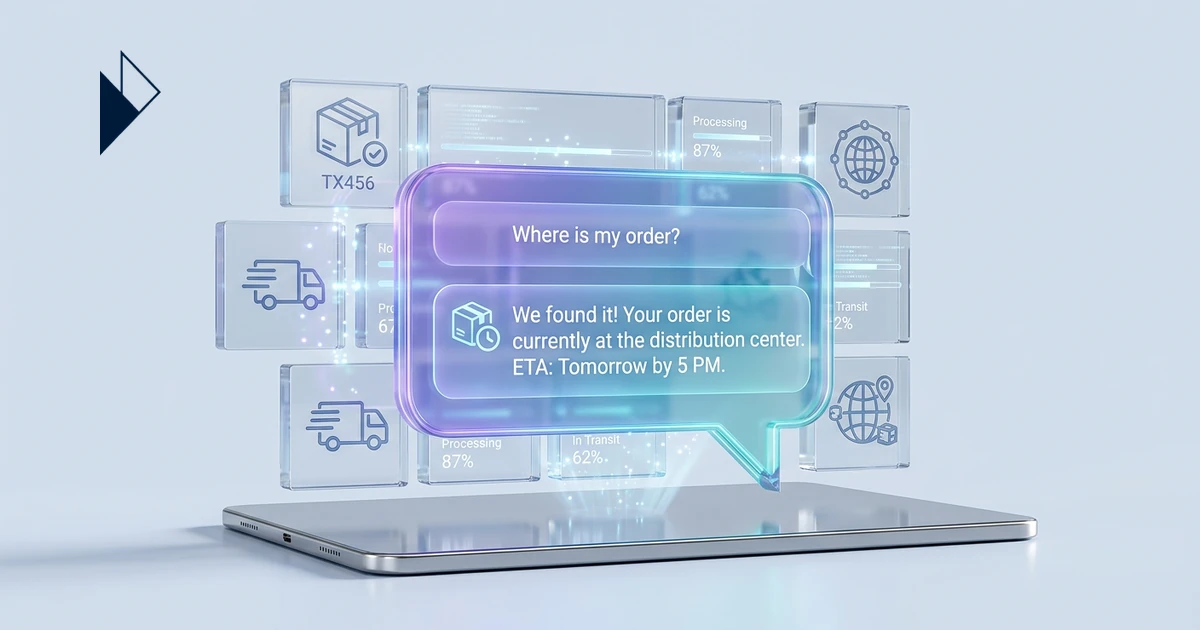
Ecommerce Conversational Commerce: Answering WISMO Inside the Chat
Stop WISMO from draining your margins. See how AI-driven chat turns delivery anxiety into scalable brand loyalty.
Aug 18, 2026
Parcel Perform