

The Delivery Landscape in the Netherlands from Q1/2024 - Q1/2025
For years, Dutch online shoppers made decisions based on product variety, price, and convenience. But over the past year, something shifted. As AI-powered shopping assistants became more common, the rules of e-commerce changed. Delivery performance quietly became the deciding factor not just in customer satisfaction, but in whether a brand even shows up in AI-driven recommendations.
In 2024, Dutch consumers spent approximately €36 billion online, marking a 5% growth from the previous year. But with more choice came higher expectations. According to DHL eCommerce's Global Online Shopper Survey, 63% of Dutch shoppers said they would abandon a purchase if their preferred delivery option wasn't available. As AI-assisted transactions continue to rise, brands with poor delivery records are being filtered out automatically.
In another edition of our Delivery Landscape series, we explore how the Netherlands' e-commerce logistics market evolved from Q1 2024 to Q1 2025, and why delivery performance has become the key to visibility, trust, and repeat business. In the Netherlands, delivery is no longer just a promise on the checkout page. It's the main driver of brand discovery, shopper loyalty, and long-term growth. Whether you're a retailer or e-commerce logistics carrier, your ability to deliver reliably is now your most powerful competitive edge.
From Convenience to Competitive Advantage: What Changed?
For years, Dutch e-commerce thrived on convenience, broad product selection, competitive pricing, and smooth checkout experiences. But in 2024, delivery in the Netherlands shifted from being a convenience to becoming a true competitive edge. Three key trends came together to drive this change:
1. Algorithmic Curation
AI-powered shopping assistants began playing a bigger role in how consumers discover brands. These systems now prioritize retailers with strong delivery records, those who consistently deliver on time, with minimal issues. If your logistics performance isn't up to par, you risk being filtered out before the shopper even sees your product.
2. Hyper-Rational Consumers
Dutch shoppers became more deliberate than ever. They're not just comparing prices, they're weighing delivery speed, reliability, and flexibility. According to DHL's Global Online Shopper Survey, 90% of Dutch consumers say delivery options influence where they shop online. That means your delivery promise is now a deciding factor, not an afterthought.
3. Retail Saturation
With more online stores than ever, standing out is harder. But one area still offers clear differentiation – delivery. In a crowded ecommerce market, consistent delivery performance is one of the few ways to build trust and loyalty. In fact, 56% of Dutch shoppers say it's important to know who the delivery provider is before confirming a purchase. This is a sign that e-commerce logistics performance is now part of the brand experience.
The Netherlands' Delivery Performance in Focus
Between Q1 2024 and Q1 2025, the Dutch delivery landscape revealed a mix of progress and pressure. While some metrics showed resilience, others exposed growing friction, especially during peak shopping periods. As AI tools became a vital part of logistics, the data provided a clear picture of where things improved and where cracks began to show.
Transit Time: Fast, But Slower in Peak Season
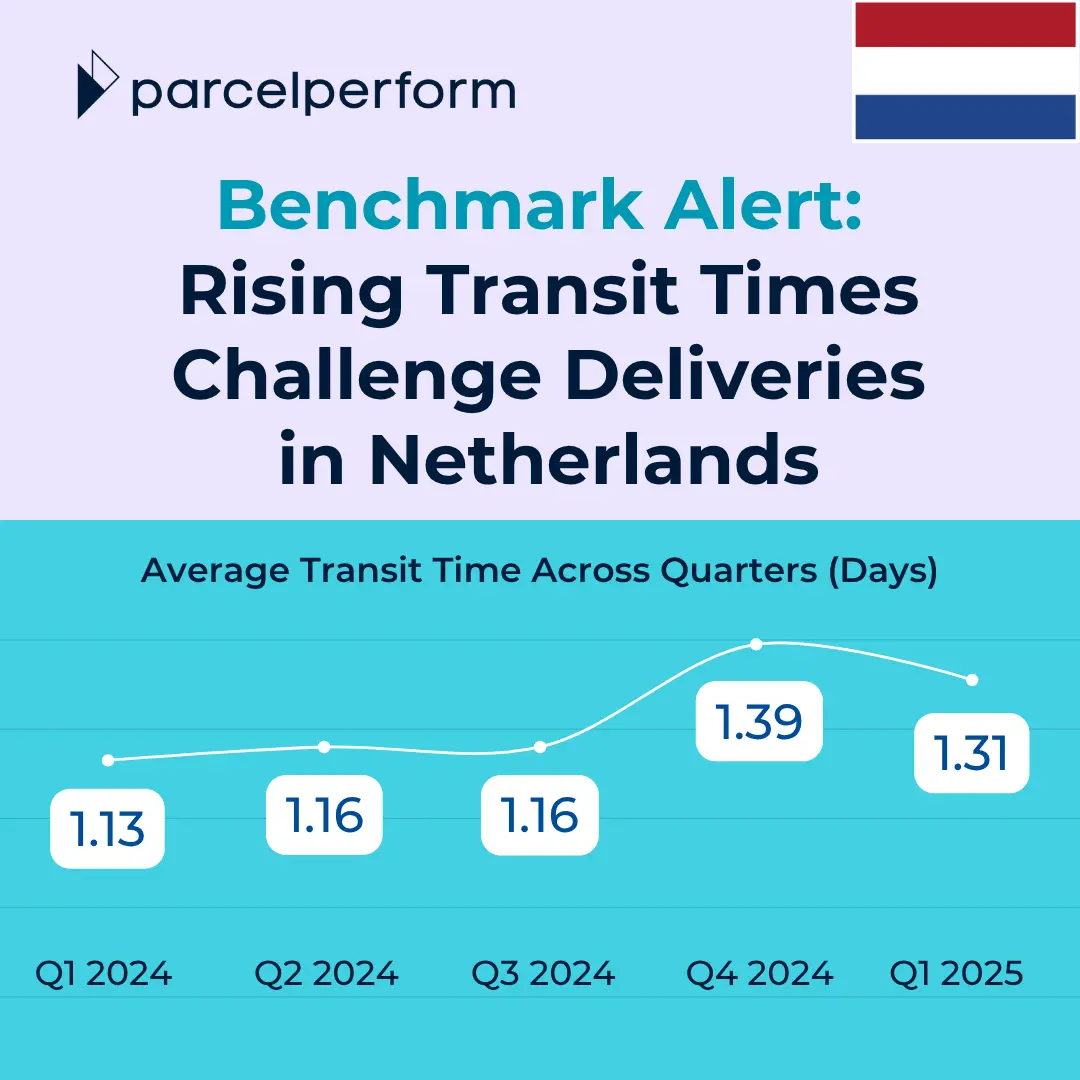
Transit times remained impressively short throughout the year, starting at 1.13 days in Q1 2024 and peaking at 1.39 days in Q4 2024. The slowdown in Q4 2024 was likely driven by the usual suspects, including Black Friday, Cyber Monday, and holiday shopping surges. Nonetheless, the fact that Q1 2025 bounced back to 1.31 days suggests that AI-powered route optimization and better forecasting helped stabilize performance after the seasonal rush.
First-Attempt Delivery Success: A Steady Decline
First-attempt delivery success ratio dropped from 96.72% in Q1 2024 to just 82.82% by Q1 2025. That's a significant fall, pointing to rising challenges in reaching customers on the first try. Whether it's missed delivery windows, incorrect addresses, or a lack of flexible delivery options, the data shows that more parcels are requiring second attempts. Thus, costing time, money, and customer satisfaction. AI commerce tools that enable real-time updates and rescheduling could play a key role in reversing this trend.
On-Time Delivery Ratio: Holding Strong
On-time delivery remained a bright spot. This metric improved from 98.02% in Q1 2024 to 98.66% in Q2, showing that Dutch carriers are doing a solid job of meeting promised delivery windows. This consistency reflects the growing use of AI-powered alerts and accurate Estimated Delivery Dates (EDDs) that help teams stay on track even as volumes fluctuate.
Issue Ratio: A Growing Concern
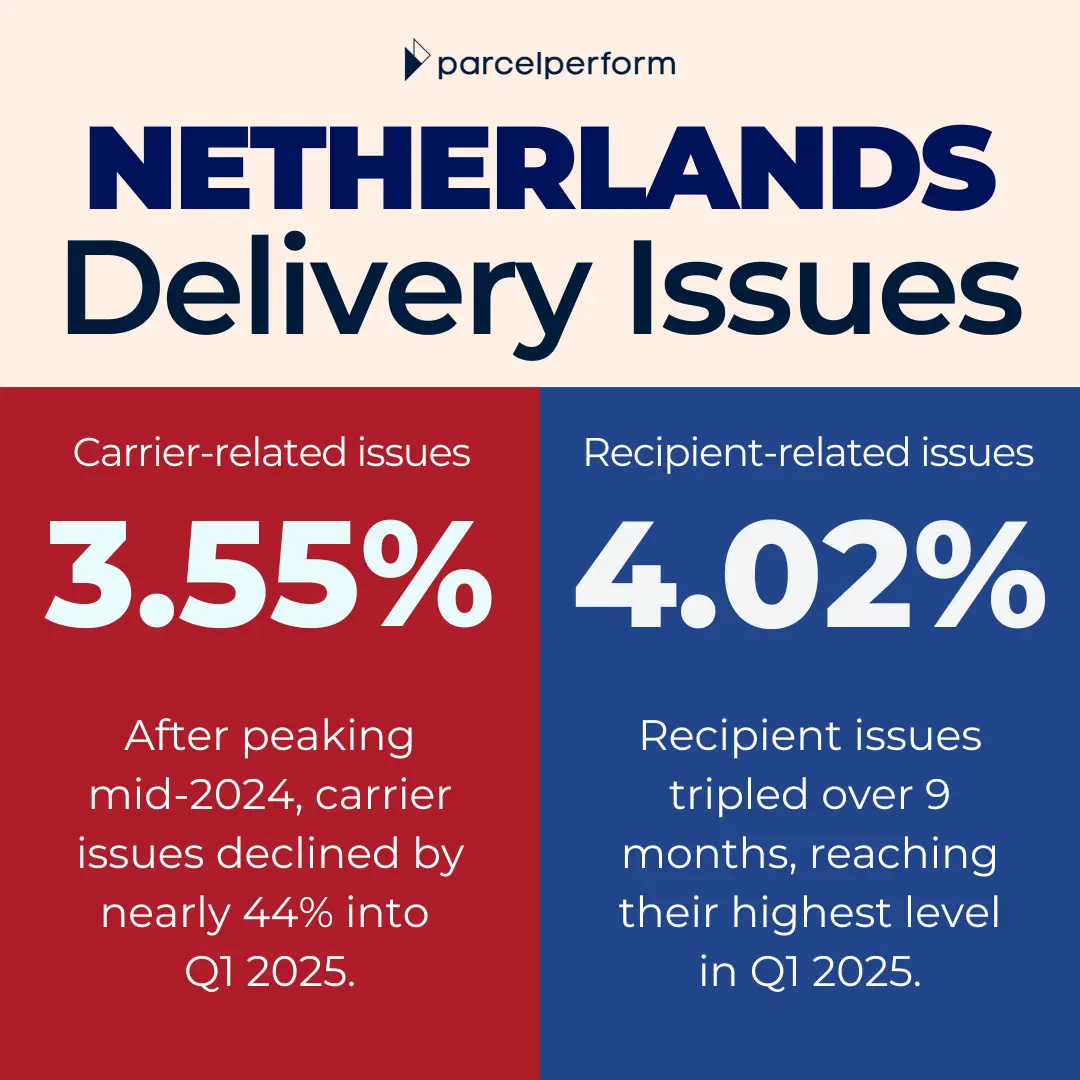
From 5.06% in Q1 2024, the issue rate climbed to 8.16% in Q3 2024 before easing slightly to 7.57% in Q1 2025. These issues, ranging from delays and failed handovers to lost parcels, often stem from carrier strain, system errors, or poor address validation. AI monitoring can help by identifying patterns early and guiding teams to act before small problems become major disruptions.
Collection Point Usage: A Seasonal Spike
Though, about 78% of online shoppers in the Netherlands prefer home deliveries. However, more Dutch shoppers are choosing parcel shops and pickup points as an alternative option, especially during peak seasons. As a result, collection point usage grew from 7.74% in Q1 2024 to 10.88% in Q4 2024, before dipping slightly to 8.93% in Q1 2025. This trend shows that flexible, self-service delivery options are gaining traction, especially when supported by smart notifications and real-time locker availability.
Dwell Time Ratio: Quiet but Steady Progress
Dwell time—the percentage of parcels collected within 24 hours—improved from 52.43% in Q1 2024 to 64.08% in Q1 2025, with a slight dip during Q4 2024's high-volume period. This suggests that better communication, smarter locker placement, and AI-led pickup point management are helping customers collect their parcels faster and more efficiently.
Together, these trends show that while the Netherlands continues to deliver at a high standard, the pressure is building. AI is helping teams stay ahead, but the real winners will be those who act on the data quickly, consistently, and with the customer in mind.
How AI Decision Intelligence Turns Data into Action
Furthermore, the delivery landscape across the Netherlands is changing really fast, and manual monitoring just can't keep up. With hundreds of moving parts across carriers, collection points, and customer touchpoints, retailers and e-commerce logistics teams need smarter tools to stay ahead. That's where AI Decision Intelligence makes the difference. This solution is turning raw delivery data into clear, daily actions that improve performance.
AI Data Monitoring - Always-On Monitoring That Spots Problems Instantly
AI Decision Intelligence continuously scans over 150 delivery metrics across your entire network, both day and night. It tracks everything in real time, from transit times and first-attempt success to dwell time and issue rate increases. When something goes wrong, it flags it immediately. Whether the problem is with a carrier, a collection point, or a specific region, you'll know about it before it becomes a bigger issue.
Daily AI Summaries - Daily Summaries That Highlight What Matters Most
Instead of digging through spreadsheets or dashboards, your team receives a focused summary every day. These summaries highlight the most urgent problems, rank them by impact, and show exactly where to act. It's a faster, clearer way to stay on top of performance. With AI Decision Intelligence, there is no guesswork or wasted time.
AI Recommendations - Smart Recommendations That Drive Real Results
Once issues are identified, AI Decision Intelligence goes a step further by offering practical suggestions. It might recommend switching carriers, adjusting delivery windows, or improving customer communication. These recommendations are based on real-time data and past performance. The solution helps teams make smarter decisions faster and keep delivery metrics moving in the right direction.
Want to see it in action? Explore our AI Decision Intelligence now.
The New Standard: Transparent, Predictable Delivery
What's more, Dutch consumers now expect more than just fast shipping, they want delivery experiences they can trust. That means clear communication at every step, accurate Estimated Delivery Dates (EDDs), and proactive updates when things go wrong.
With over 80% of Dutch shoppers buying online and millions using apps to personalize their delivery preferences, the bar has been raised. It's no longer enough to promise speed. Shoppers want to know exactly when their parcel will arrive, who's delivering it, and what to expect if something changes.
For retailers and carriers, this shift is more than a customer service challenge, it's a visibility opportunity. In a market where AI-powered platforms are curating product recommendations based on performance, brands that deliver consistently and communicate clearly will rise to the top. In the Netherlands, predictable delivery is quickly becoming the standard that separates trusted brands from the rest.
Reliable Delivery Is Now Your Competitive Edge
In conclusion, the past year has made certain things clear in the Netherlands. Delivery performance is no longer just a backend operation, it's a front-row factor in how shoppers discover, trust, and return to your brand. From faster transit times to smarter pickup strategies, the retailers and carriers who embraced data and acted quickly were the ones who stayed visible and competitive. As AI continues to shape how products are ranked and recommended, your delivery data is now part of your brand reputation.
To stay ahead, Dutch retailers and logistics providers need more than speed. They need transparency, predictability, and real-time decision-making. That's where AI Decision Intelligence comes in. The solution helps you monitor what matters, fix issues before they grow, and deliver the kind of experience that earns loyalty and boosts discoverability. Want to see how it works? Book a demo with Parcel Perform and turn your delivery performance into your next growth driver.
The Netherlands Delivery in the Age of AI Commerce – Top 3 Questions Answered
1. Why does delivery impact discoverability in AI-powered shopping? In the age of AI commerce, delivery performance plays a big role in how visible your brand is. Algorithms now look at real delivery data, such as transit time, on-time rates, and issue ratio, when deciding what to recommend. In the Netherlands, where online shopping is the norm, brands that deliver reliably are more likely to be seen. It's no longer about what you promise. It's about what you consistently deliver.
2. Which metric matters most? Two metrics stand out: accurate Estimated Delivery Dates (EDDs) and first-attempt delivery success. EDDs help set clear expectations at checkout, while first-attempt success shows how well your delivery network performs. Together, these metrics indicate trust and reliability. These are two things AI platforms and Dutch shoppers value highly.
3. What's the fastest way to improve delivery performance? Start with AI tools like AI Decision Intelligence that monitor your delivery data in real time. They flag issues early, prioritize what needs fixing, and suggest actions that improve results, such as switching carriers or adjusting delivery windows. This remains a faster, smarter way to stay ahead without relying on manual tracking.
You might also like
Ecommerce Conversational Commerce: Answering WISMO Inside the Chat
Stop WISMO from draining your margins. See how AI-driven chat turns delivery anxiety into scalable brand loyalty.
Aug 18, 2026
Parcel Perform
Ecommerce AI Returns Management: Cutting Reverse-Logistics Cost with Prediction
Cut reverse logistics costs with e-commerce AI returns management. Turn return data into margin protection and profit.
Aug 17, 2026
Parcel Perform
Ecommerce AI Personalization: Using Post-Purchase Behavior to Tailor Experience
Turn post-purchase behavior into a retention engine. See how AI personalization drives loyalty and cuts WISMO.
Aug 14, 2026
Parcel Perform